Research
Firefighting in crew planning: why 88% of operators react instead of plan
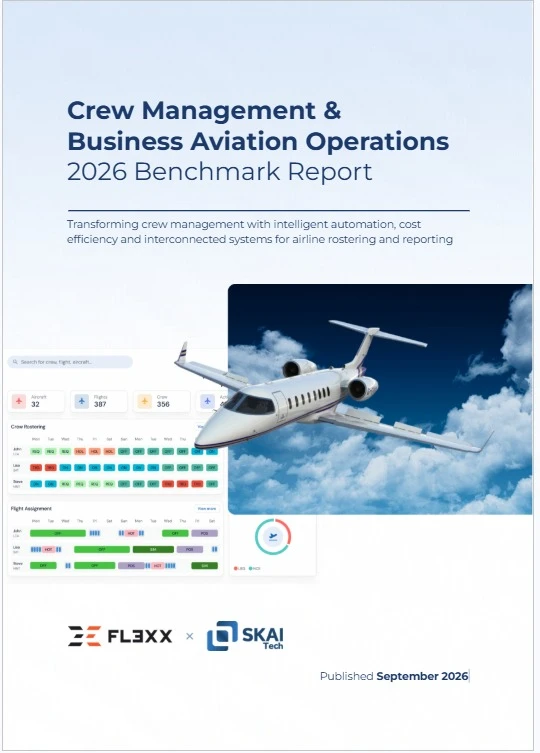
The FL3XX × SkAI Tech Crew Management Benchmark 2026 finds that 88% of the business aviation operators surveyed spend significant time reacting rather than planning: 65% split their energy between the two, 23% operate in permanent firefighting mode. The report's thesis: what separates operators is not how often disruption arrives, but how much of it their roster absorbs.
“Firefighting” comes up in almost every conversation with a crew planning manager, and it is usually treated as a fact of the job: aviation is a disrupted business, so planning must be reactive work. The 2026 benchmark shows why that explanation does not hold, and what it hides.
What does firefighting mean in crew planning?
Firefighting is the working regime in which most of a crewing team's time goes on events that have already happened: an absence to cover, an added flight, a rotation that slips, a crew that will no longer be legal on arrival. What these tasks share is a short deadline and a forced answer. You do not choose the best response; you take the one that exists.
Managing disruption is something else. Every flight operation manages disruption. Firefighting begins when handling disruption takes the time that should go into building the next roster, and a roster built in whatever time is left generates more disruption in turn. The loop then feeds itself.
What exactly does the benchmark measure?
The report puts numbers on each face of that regime. Every value below comes from the FL3XX × SkAI Tech Crew Management Benchmark 2026, run with 30 business aviation operators flying from fewer than 5 to more than 30 aircraft.
| Indicator | Value |
|---|---|
| Operators spending significant time firefighting | 88% |
| of which energy split between planning and reacting | 65% |
| of which permanent firefighting | 23% |
| Operators describing their staffing as “stretched” | 81% |
| Operators not “very confident” in their rostering process | 85% |
| Operators with a dedicated Ops/Crewing team | 85% |
| Typical size of that team, fleets up to 15 aircraft | 1 to 3 people |
| Human factors as leading driver of unplanned changes | 77% |
| Leave and preferences collected by phone, WhatsApp or email | roughly half |
Two readings matter. First, firefighting affects nine operators in ten; this is no fringe condition. Second, it cannot be blamed on missing organisation, since 85% of operators do have a dedicated team. Centralised crewing is already in place. It is not enough.
Why doesn't disruption frequency explain anything?
This is the report's central argument: “What separates operators is therefore not how often disruption arrives, but how much of it their roster can absorb. The same sick call is a non-event for an operation with slack, and a cancelled charter for one without.”
That sentence relocates the diagnosis. Two comparable operators, same market, same fleet, face roughly the same volume of disruption: sick calls do not distribute themselves according to the quality of the planning software. What differs is what the roster does with the disruption.
A roster carrying slack in the right places turns a sick call into a non-event: someone is available, qualified, within reach, and the replacement costs neither an arbitration nor budget. The same sick call, on a roster with no slack, travels up the chain: find a replacement, choose between two missions, buy capacity on the market, or cancel.
Network data points the same way. Per EUROCONTROL's CODA Digest, 46% of European delay minutes in 2024 were reactionary, at 8.0 minutes per flight: nearly half of Europe's delay is not the initial disruption but its propagation through sequences nothing absorbs (see our article on roster reliability and delay).
The corollary matters for anyone running an operation: the number of incidents handled per month says nothing about performance. A team handling thirty disruptions a month is doing no worse than one handling ten; it may simply be working on a roster that absorbs none of them. The measure worth tracking is the share of disruptions that needed a human intervention.
Where does slack come from, and why does it vanish?
Slack is not overstaffing; it is a product of distribution. Days off placed where they block nothing, positioning grouped together, duty counters kept at a distance from the limit rather than flush against it.
It vanishes for a structural reason the same report documents. The number of possible rosters reaches 1.4 × 10²³ for just 14 flights and 10 crew members: at that scale, a planner cannot compare alternatives. They stop at the first acceptable roster. And the first acceptable roster is, by construction, one without slack: nothing in the search pushed towards keeping any.
The cost of that missing slack never shows in the planning budget. It shows as aircraft that could have flown and stayed on the ground for lack of crew, and it grows with the operation: the bigger the fleet, the more combinations there are, and the wider the gap between the roster found and the best one available.
Why can't a three-person team work its way out?
Because firefighting comes from a shortage of information at the moment of decision, far more than from a shortage of hands.
A team of 1 to 3 people covering a fleet of up to 15 aircraft, the typical set-up in the benchmark, can process the volume of tasks. What it cannot do is know, at the moment it places an assignment, what that assignment will do three weeks later at another base. Propagation is invisible from the desk.
Two aggravating effects, both documented in the report:
- Informal channels. Roughly half of operators collect leave and preferences by phone, WhatsApp or email, with no structured system. The information exists, but it is not in the model when the decision is made.
- The fatigue loop. Human factors are the leading driver of unplanned changes (77%). A roster rebuilt under time pressure loads the available crew harder, which feeds precisely the factor that will produce the next disruption.
There is also an informal shock absorber the report brings to light: in smaller organisations it is often the executive, who simply flies more when a pilot is missing. That works up to a certain volume, at the cost of leadership time that is then not spent breaking the loop.
How do you move from reacting to absorbing?
The report sets out five characteristics expected of a modern solution. Read through the firefighting lens, they describe less a feature list than a change in when the work happens:
- A unified view of the problem: the long-term roster evaluated in a single constraint context, instead of a chain of local decisions.
- Continuous feasibility evaluation: problems detected ahead of the disruption, while internal options still exist.
- Visibility on constraint margins: knowing how close each activity sits to its limit, and therefore where a disruption is absorbed and where it costs a mission.
- Propagation awareness: local changes assessed for their network consequences, which no planner can do unaided.
- Risk-based prioritisation: problems ranked by operational impact, so the team's time goes where it changes an outcome.
Airline leadership is looking at the same place: in Deloitte's 2025 survey of 32 airline CEOs, 50% expect AI's biggest impact over the next three years in customer service and irregular operations recovery.
Mathieu Leroi, Senior Crew Manager at Jetfly Aviation, describes what that shift produces: planning stops being reactive work and becomes an input into company decisions.
“SkAI Tech gives me alerts that I bring into our staffing meetings, so management can make the right calls: recruitment, fleet changes, better distribution across bases.”
The measured effects point the same way. Across SkAI Tech deployments in 2025-2026 (outcomes vary with fleet size and operating model), the report records 1 h 30 saved every day on daily operations, with disruption-driven changes handled automatically; 15% fewer additional duty days; 19% less duty spread between crew members and 14% more requested days off granted; +21 points of direct flight coverage, by releasing +0.42 duty days per pilot per month.
None of this requires replacing the operations system: SkAI Tech connects as an API add-on to the existing platform, FL3XX among them, which remains the source of truth for flights and crew.
Spending your days putting out fires? See how SkAI Tech absorbs disruption for crew schedulers.
How do you know whether you are leaving firefighting behind?
Four indicators, all measurable without additional tooling:
- Average lead time on detecting a coverage problem. If it is counted in days rather than hours, internal options still exist.
- Share of disruptions handled without human arbitration. This is the direct measure of absorption in the report's sense.
- Number of changes after roster publication. A stable roster is one that was built with slack.
- Distribution of effort across crew members. If the same people absorb every disruption, slack was never created; it was borrowed, and it gets repaid in fatigue or resignations.
FAQ
Does 88% mean crew planning teams are doing a bad job?
No, and the report says the opposite: 85% of operators have a dedicated Ops/Crewing team, so the organisation exists. Firefighting comes from the fact that a team of 1 to 3 people cannot evaluate the network consequences of every decision across a twenty-four-digit solution space. No amount of competence gets past that computational limit.
Can firefighting be eliminated entirely?
No. Disruption keeps arriving, and human factors will remain the leading driver of unplanned changes (77% in the benchmark). The goal is not to remove disruption but to increase the share the roster absorbs without intervention, and to detect the rest early enough to solve it with internal crew.
Does the 88% figure apply to regional, ACMI or medevac operators?
Not as it stands. The benchmark covers business aviation. The mechanism it describes, a roster without slack turning every disruption into an intervention, is not specific to the segment; the percentages, however, should not be presented as valid elsewhere without a separate source.
Should we hire into the crewing team to break the loop?
Rarely as the first move. Hiring increases the capacity to process interventions; it does not reduce the number of interventions a tight roster produces. The report's results (1 h 30 saved per day, 15% fewer additional duty days) address the second quantity.
Sources
- FL3XX × SkAI Tech (2026, August), Crew Management & Business Aviation Operations — 2026 Benchmark Report: survey of 30 business aviation operators, absorption thesis, combinatorial explosion, five characteristics of a modern solution.
- SkAI Tech deployment results 2025-2026, quoted with the report's caveat: results observed across these deployments, varying with fleet size and operating model.
- EUROCONTROL (2025, 25 July), All-Causes Delays to Air Transport in Europe — Annual 2024 (CODA Digest): reactionary delay at 46% of delay minutes, 8.0 minutes per flight, Europe/ECAC, 2024.
- Deloitte (2025), CEO compass: Deloitte Global's 2025 Airline CEO Survey, 32 airline CEOs surveyed.