Research
The combinatorial explosion: why no one finds the best roster by hand
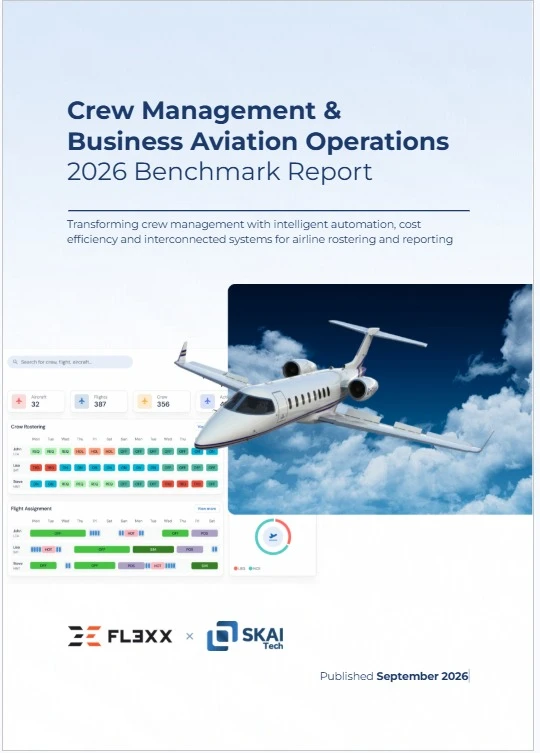
A pool of 14 flights and 10 crew members admits 1.4 × 10²³ possible rosters, according to the FL3XX × SkAI Tech Crew Management Benchmark 2026. At 1,000 rosters per second, working through them all would take 321 times the age of the universe. No planner can look for the best roster, so they stop at the first one that meets the rules.
That number is the most quotable finding in the Crew Management & Business Aviation Operations 2026 Benchmark Report, and it quietly explains most of the others: the time spent reacting, the strain on crewing teams, the reliance on freelance capacity. None of it says anything about the competence of the people involved. The sheer size of the problem accounts for it.
How many rosters are we talking about?
The benchmark builds its demonstration on a deliberately tiny scope: 14 flights and 10 crew members. No fleet, no month-long programme, no network of bases, just a fragment of an operation that a chief pilot would expect to settle in their head.
That fragment admits 1.4 × 10²³ possible rosters, a twenty-four-digit number. The report gives the one comparison that makes it tangible: a planner able to evaluate 1,000 complete rosters every second would need 321 times the age of the universe to look at them all.
The same report notes that on a realistic scope, the count of feasible crew-to-flight assignments alone already runs into the millions of combinations. Long before anyone talks about choosing well, the solution space has passed the point where it can be inventoried at all.
Why does the number grow so fast?
Intuition fails here because intuition is additive. A roster looks like a list of rows, so adding a flight looks like adding a row to fill. In reality, an extra flight does not add to the problem: it multiplies it.
Every flight in the period can be crewed by several different crew compositions. In a pool of ten people, the number of possible pairs already runs into the dozens. A complete roster combines all of those choices at once, so the fifteenth flight combines with every configuration that was already possible for the first fourteen. The count does not go from N to N + 1, but from N to a multiple of N.
Three further multipliers show up in any real operation:
- Time. A roster is a sequence, not a set of independent decisions. An assignment on the 3rd constrains what is still legal on the 5th, the 12th and the 28th, because duty, rest and days-off counters accumulate (see the EASA FTL rules). Every decision reshapes the space of decisions still available.
- Qualifications. Crew hold type ratings on aircraft that are not interchangeable. A pool of ten is not a pool of ten: it is several sealed sub-pools that rule certain combinations out, and the infeasibility often only shows once the combination has been built.
- Geography. Crew have to reach the aircraft. Every positioning leg is itself a decision, with its own timing and its own consumption of duty time.
The conclusion runs against the usual assumption: enumeration is out of reach at the scale of a fraction of a week, well before the fleet grows. Growth only makes heavier a problem that was already beyond mental arithmetic.
What does a planner actually do with that number?
They settle for the first acceptable roster, since looking for the best one is off the table. That is rational behaviour: when the space cannot be inventoried, stopping as soon as the constraints are satisfied is the only strategy available.
The difference is invisible on the published roster, and it has three consequences:
- Roster quality is never measured. A compliant roster is a roster that ships. Nobody knows how far it sits from the best compliant roster, because nobody has seen that one. The gap appears in no KPI.
- Arrival order becomes the arbitration rule. Without a way to compare complete solutions, requests get handled in the order they land. The benchmark finds that roughly half of operators collect leave and preferences by phone, WhatsApp or email, with no structured system: the first message in wins (see our article on crew leave planning).
- Slack disappears unnoticed. Nothing in the search pushed towards keeping reserve where it will be needed, so the first acceptable roster is usually a tight one, and its brittleness only surfaces at the first disruption. That is the mechanism behind firefighting in crew planning.
Why is business aviation a worst case?
Because it stacks the aggravating factors. Every figure below comes from the FL3XX × SkAI Tech Crew Management Benchmark 2026 survey of 30 business aviation operators running from fewer than 5 to more than 30 aircraft.
| How crews are organised | Share of operators |
|---|---|
| Combine several rostering logics | 77% |
| Fixed rotation patterns (7/7, 7/5…) | 54% |
| Dynamic pooling | 46% |
| Crew permanently dedicated to one aircraft | 38% |
| Multi-base operation | 58% |
| Fully distributed, home-based crew | 31% |
These models coexist rather than replace one another. One operator can run a dedicated crew on one tail, dynamic pooling on two others and a fixed pattern at a secondary base. Each logic brings its own constraints, and all of them have to hold in the same roster: the trade-off that satisfies one is often paid for by another.
Then there is the nature of the work: flights sold at short notice, rotations that move after the roster is published, and lean teams. The same benchmark finds that 85% of operators have a dedicated Ops/Crewing team, but that it typically consists of 1 to 3 people for fleets of up to 15 aircraft. And 85% of operators are not "very confident" in their rostering process; only 15% are.
A twenty-four-digit solution space, arbitrated by one to three people. Read that way, the low confidence looks less like pessimism than like an accurate reading of the situation.
How does constraint optimisation escape the enumeration trap?
Not by brute force. A solver does not walk through every roster; it examines a vanishingly small fraction of them. What it brings is a way to prove which ones it can safely ignore.
- Constraints eliminate whole regions. Modelling FTL limits, qualifications, rotation patterns and company rules is not only about checking a finished roster. It lets the solver rule out an entire family of infeasible combinations without building a single one of them.
- An objective makes "better" explicit. Positioning cost, fairness of the duty spread, robustness to disruption, honoured requests: until those are written down, the only question you can ask a roster is "is it legal?". Once they are, the question becomes "is there a better one, and by how much?".
- Bounds tell you when to stop. The solver computes how far the current solution sits from the optimum. It can then stop deliberately, rather than at the first thing that passes.
Our article on AI crew roster optimisation covers that mechanism in detail. The report draws from it five characteristics of a modern solution, which double as an evaluation grid for any vendor:
- Unified view of the problem: the long-term roster evaluated in a single constraint context.
- Continuous feasibility evaluation: problems caught before the disruption.
- Visibility on constraint margins: how close each activity sits to its limit.
- Propagation awareness: local changes assessed for their network consequences.
- Risk-based prioritisation: problems ranked by operational impact.
What changes on the ops floor?
Moving from "first acceptable" to "best against explicit objectives" shows up in operating numbers. The results below come from the report, observed across SkAI Tech deployments in 2025-2026, and vary with fleet size and operating model.
| Effect | Measure |
|---|---|
| Direct flight coverage | +21 points, by releasing +0.42 duty days per pilot per month |
| Freelance duty days | down by up to 40% |
| Duty spread between crew members | −19% |
| Requested days off granted | +14% |
| Additional duty days | −15% |
| Daily operations | 1 h 30 saved per day |
Read together, those numbers say the missing capacity existed all along, just in the wrong places. The report puts it in one line: “The most expensive aircraft is the one sitting on the ground for lack of crew. SkAI Tech releases capacity you already pay for.”
On the computing side, operators running SkAI Tech generate a complete roster in 12 minutes on average and see 20% fewer roster deviations. Those results are observed across 2025-2026 deployments, over a scope of more than 70 aircraft and 900 crew members, and vary with fleet size and operating model. None of it requires replacing the operations system: SkAI Tech connects as an API add-on to the platform already in place, FL3XX among them, which remains the source of truth for flights and crew.
Still building rosters by hand? See how SkAI Tech compares millions of rosters for crew schedulers.
FAQ
Does 1.4 × 10²³ mean a hand-built roster is wrong?
No. A manual roster is usually perfectly compliant: compliance is precisely the planner's stopping rule. The FL3XX × SkAI Tech Crew Management Benchmark 2026 figure says nothing about legality. It says that among all the compliant rosters available, nobody knows where the published one sits, or what it costs relative to the best one.
Does software really test all 1.4 × 10²³ combinations?
No, and that is the whole point. A solver does not enumerate: it models the constraints, reasons entire families of solutions out of contention, and computes bounds on the gap left to the best possible solution. That is what brings computation down to minutes.
Does this apply to a regional airline, an ACMI operator or a medevac fleet?
The combinatorics do: they depend on flights, crew and constraints, not on the segment, and they get heavier as the fleet grows. The survey percentages quoted here, however, cover business aviation only, which is the scope of the benchmark. They should not be presented as valid for regional, ACMI or medevac operations.
Do we have to change operations systems to address this?
No. Optimisation connects as an API add-on to the operations system already in place, which stays the source of truth. At SkAI Tech, connecting to an already supported FMS takes about an hour, and most operators are live within four weeks: an operations project, not an IT migration.
Sources
- FL3XX × SkAI Tech (2026, August), Crew Management & Business Aviation Operations — 2026 Benchmark Report: combinatorial demonstration (14 flights, 10 crew members, 1.4 × 10²³ rosters), survey of 30 business aviation operators, five characteristics of a modern solution.
- SkAI Tech deployment results 2025-2026, quoted with the report's caveat: results observed across those deployments, varying with fleet size and operating model.
- SkAI Tech indicators (first-party data): average generation time and reduction in roster deviations observed across 2025-2026 deployments, over more than 70 aircraft and 900 crew members.