Regulations
FRMS and fatigue risk management: beyond the FTL limits
A Fatigue Risk Management System (FRMS) is a safety management process that measures and controls crew fatigue risk using data, where flight time limitations only draw legal boundaries. FTL tells you what is permitted; fatigue risk management tells you whether the roster you actually built keeps alertness at an acceptable level.
Any planner meets this gap eventually: two rosters can be equally compliant with ORO.FTL and very unequal in how tired they leave the crew, and nothing in the FTL text will tell them apart. This article sets out what the regulation actually requires on fatigue, how roster fatigue is measured, and how to build it into the roster from the start.
Why isn't FTL compliance enough?
Flight time limitations are a legal instrument: a set of prescriptive, uniform boundaries that can be applied without judgement. That is their strength, since they are auditable, and also their ceiling. The gap between “legal” and “rested” comes down to what the rules can and cannot see:
- FTL bounds duration, not shape. Two sequences with identical total hours can differ sharply: four duties at a stable report time do not build the same sleep debt as the same four duties in backward rotation, each starting an hour earlier.
- FTL does not know what sleep was actually obtained. Ten hours of rest away from base is ten hours of rest to the regulation, regardless of hotel noise, time-zone displacement or the transfer from the airport.
- FTL does not accumulate fatigue beyond its own counters. Rolling caps limit workload volume, not the sleep debt built across a run of short duties badly placed in the day.
The regulation says as much itself. ORO.FTL.110 does not stop at the numbers: the operator must plan flight duty periods so that crew members remain “sufficiently free from fatigue” to operate to a satisfactory level of safety under all circumstances, taking account of cumulative effects and the disruption of sleep patterns. ORO.FTL.250 adds initial and recurrent fatigue management training.
What does EU regulation actually require?
The topic is often presented loosely, vendor conversations included. Three levels need to be kept apart.
- The general duty, for everyone. Every operator under Subpart FTL must build rosters that keep crews free from fatigue (ORO.FTL.110) and train crew and rostering staff in fatigue management (ORO.FTL.250). This works inside the prescriptive limits.
- FRM where the rules call for it. ORO.FTL.120 describes fatigue risk management (FRM) as an integral part of the management system, set out in the operations manual, but makes it mandatory only “when FRM is required by this Subpart or an applicable certification specification”. That includes extending an FDP when the crew is in an unknown state of acclimatisation (ORO.FTL.205) and using reduced rest (CS FTL.1.235). Night and late-finishing duties call for a lighter “appropriate FRM”, which the guidance material distinguishes from the full system.
- FRM in support of a deviation. An operator wishing to deviate from the certification specifications must give the authority a full description of the deviation, with an assessment showing safety is maintained, then collect data and analyse it using scientific principles (ORO.FTL.125). Flight time specification schemes, including any related FRM, are approved by the authority before they are implemented.
Where it is required, FRM has seven components (ORO.FTL.120): an FRM policy, documentation of its processes, scientific principles and knowledge, a hazard identification and risk assessment process, a risk mitigation process, safety assurance processes and promotion processes. It is the architecture of a safety management system applied to one specific hazard.
The international frame is ICAO's. Annex 6, Part I, section 4.10 makes prescriptive limitations mandatory and leaves FRMS regulations optional for each State; operators can then manage fatigue through prescriptive limits, or through an FRMS for all or part of their operations. The Manual for the Oversight of Fatigue Management Approaches (Doc 9966) details the implementation.
The frame is getting tighter for air taxi and AEMS. The delegated regulation the Commission adopted on 8 September 2026 creates a Subpart FTL (B) that requires these operators to implement fatigue risk management, supported by the management system or by an FRMS where one is required, and restricts reduced rest in particular to operations under an effective FRMS. Most of it applies from 15 October 2028 (see our article on medevac crew scheduling).
How is roster fatigue actually measured?
Fatigue management draws on three families of data, complementary and never interchangeable:
- Predictive data: output from biomathematical fatigue models. Given roster times, these models estimate expected alertness by combining the circadian rhythm, the sleep pressure that builds with time awake, and sleep inertia. The most cited are SAFTE-FAST (Steven Hursh's SAFTE model, in software from the Institutes for Behavior Resources), Åkerstedt and Folkard's Three-Process Model, and the Boeing Alertness Model marketed by Jeppesen, derived from the latter. EASA guidance lists them among the predictive methods of hazard identification.
- Subjective data: collected from crew through validated scales such as the Samn-Perelli fatigue scale (7 points) or the Karolinska Sleepiness Scale (9 points), and through fatigue reports.
- Objective data: sleep measured by actigraphy, psychomotor vigilance testing (PVT), operational data.
One methodological point deserves to be stated plainly, because it is routinely blurred: a model output is a population-level estimate, not an individual measurement. The fatigue management guide published by IATA, ICAO and IFALPA is explicit: biomathematical models are an optional tool among others, they do not constitute an FRMS on their own, and operational decisions should not rest solely on their thresholds. An alertness score proves neither compliance nor the fitness of one crew member on one day. Its use is to compare roster options and flag atypical sequences.
Which rostering choices generate the most fatigue?
The known risk factors are all visible in the shape of the roster, which is what makes them actionable at construction time:
| Factor | Effect | Rostering lever |
|---|---|---|
| WOCL infringement (02:00 to 05:59) | Alertness trough, degraded recovery sleep | Cap consecutive duties infringing the WOCL |
| Very early report times | Sleep truncated at the front, hard to recover | Avoid stacking early starts on the same crew member |
| Backward rotation (each day earlier) | The body clock adjusts poorly in that direction | Prefer progressive delay over progressive advance |
| Consecutive duties without a full local night | Cumulative sleep debt | Place recovery rest before the debt sets in |
| Repeated time-zone crossings | Circadian desynchronisation | Sequence long-haul rotations rather than clustering them |
| Long standby followed by a duty | Extended wakefulness before the duty even starts | Control standby duration and how it counts |
| Many sectors late in the duty day | Workload in the alertness trough | Spread dense days across the month and the crew pool |
None of these is prohibited. Each is a matter of dose, and dose is precisely what FTL cannot express and fatigue risk management can.
How do you build fatigue into roster generation rather than audit it afterwards?
The common practice is a post-hoc check: build the roster, run it through the model, then patch whatever comes out red. That beats doing nothing, but it is a weak loop. Patching a finished roster tends to move fatigue around rather than remove it, and every patch reopens the compliance question.
The more robust approach treats fatigue factors as constraints and objectives of the computation, at generation time:
- As hard constraints: the in-house rules you never cross (“no more than N consecutive duties infringing the WOCL”, “no backward rotation beyond X hours of shift”).
- As objectives to minimise: the total count of penalising sequences and, just as important, their distribution across the crew pool. Evenly spread fatigue exposure is an optimisation objective in the same way cost is.
That is what a constraint-based engine makes possible. At SkAI Tech, regulatory rules and the operator's own rules are configured together: a company fatigue policy is encoded at the same level as legal limits, and therefore checked at generation rather than at review. The product is neither an FRMS nor a certified fatigue model. It is the layer that makes the rules a fatigue management process produced enforceable across a full month and a full crew list.
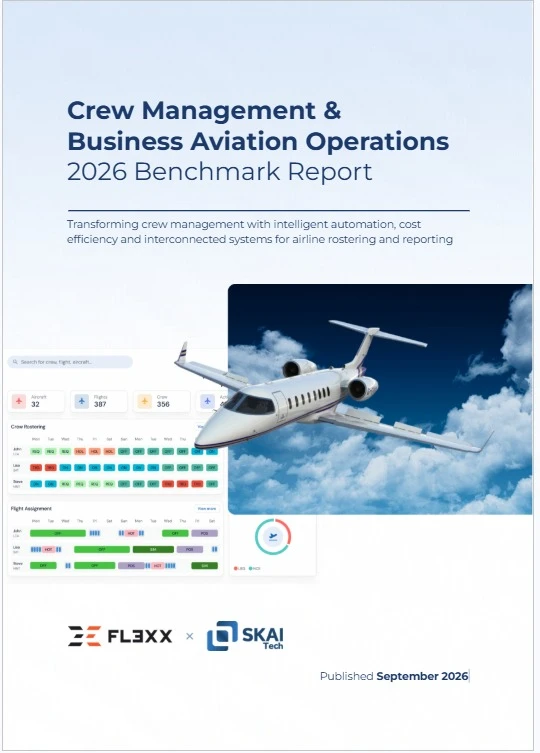
The effect shows on workload indicators such a process tracks. Across SkAI Tech deployments in 2025-2026, the FL3XX × SkAI Tech 2026 benchmark records 15% fewer additional duty days and 19% less duty spread between crew members. These measure workload and fairness, not fatigue, and they vary with fleet size and operating model.
Want your fatigue rules applied when the roster is generated? See how SkAI Tech encodes your in-house rules for crew schedulers.
Where do you start?
A mid-sized operator does not need to begin with an approved deviation. A realistic progression:
- Open a fatigue reporting channel that crew can use without consequence, and document it. No data, no risk management.
- Analyse reports by rostering cause, not only by individual: which sequences keep coming back?
- Write two or three in-house rules from that analysis, stricter than FTL on the specific points identified.
- Encode those rules in the planning tool so they apply at generation, not at review.
- Measure: fatigue reports, roster deviations, reserve call-outs.
- Consider full FRM and a deviation only if the operation genuinely needs to depart from the certification specifications, never as an end in itself.
FAQ
Does an FRMS let you fly crews longer?
Not by itself. Any deviation from the certification specifications must be described, backed by a safety assessment and approved by the authority, then monitored with data analysed using scientific principles (ORO.FTL.125). And fatigue analysis just as often leads to avoiding perfectly legal sequences.
Does a biomathematical model score prove compliance?
No. These models estimate expected average alertness for a given schedule. They do not measure an individual's state and they replace neither the FTL limits nor fitness-for-duty judgement. Their value is comparative: ranking roster options and documenting a risk assessment.
Can FTL and fatigue management contradict each other?
They answer different questions: FTL sets boundaries, fatigue management assesses exposure. The common case is a legal sequence that fatigue analysis recommends avoiding. That is the system working as designed, not a contradiction.
We operate under a national regime (air taxi, EMS). Does this apply to us?
Today, air taxi and aeroplane EMS remain under national law and Subpart Q of Regulation (EEC) No 3922/91; what they require on fatigue depends on the country and the AOC, and should be confirmed with the authority. From 15 October 2028, Subpart FTL (B) will explicitly require fatigue risk management, and an FRMS in certain cases such as reduced rest.
Sources
- EASA, Easy Access Rules for Air Operations (March 2026 revision), Part-ORO Subpart FTL: ORO.FTL.105 (WOCL definition), ORO.FTL.110 (operator responsibilities), ORO.FTL.120 (FRM), ORO.FTL.125 (flight time specification schemes and deviations), ORO.FTL.205, ORO.FTL.250 (training), CS FTL.1.205 and CS FTL.1.235, AMC1 ORO.FTL.120(b)(4).
- European Commission (2026, 8 September), Delegated Regulation C(2026) 6142 final amending Regulation (EU) No 965/2012 for air taxi, emergency medical services and single-pilot operations (Council document 12992/26): Subpart FTL (B), fatigue risk management and FRMS, application from 15 October 2028.
- ICAO, Annex 6, Part I, section 4.10 (fatigue management); Doc 9966, Manual for the Oversight of Fatigue Management Approaches, second edition (revised version, 2020).
- IATA, ICAO, IFALPA (2015), Fatigue Management Guide for Airline Operators: use of biomathematical models, Samn-Perelli and Karolinska scales.
- Hursh, S. R. et al. (2004), Aviation, Space, and Environmental Medicine, 75(3 Suppl.): SAFTE model; Institutes for Behavior Resources, SAFTE-FAST software.
- Åkerstedt, T. and Folkard, S. (1995), Sleep: three-process model of alertness; Ingre, M. et al. (2014), PLoS One: Boeing Alertness Model, derived from the three-process model.
- Samn, S. W. and Perelli, L. P. (1982), USAF SAM-TR-82-21; Åkerstedt, T. and Gillberg, M. (1990), International Journal of Neuroscience, 52; Dinges, D. F. and Powell, J. P. (1985), Behavior Research Methods, Instruments, & Computers, 17.
- FL3XX × SkAI Tech (2026, August), Crew Management & Business Aviation Operations — 2026 Benchmark Report: 2025-2026 deployment results, varying with fleet size and operating model.