Operations
AI crew roster optimization: what operations leaders need to know
AI crew roster optimization means having an algorithm generate, in minutes, a roster that satisfies every rule (FTL, qualifications, company constraints) while minimising cost and balancing workload across crew members. Where a human planner searches for one feasible roster, the algorithm compares millions and keeps the best one.
"AI" has become a sales word with the meaning worn off. This article lays out what roster optimization actually is, what it changes in practice, with numbers, and what to ask a vendor before signing. It is written for the person who owns the operations budget rather than the person who writes the code.
The topic is no longer a side conversation in the boardroom either. In Deloitte's 2025 survey of 32 airline CEOs, 47% name AI and machine learning as an investment priority, 63% prioritise advanced data analytics for the year ahead, and 50% expect AI's biggest impact over the next three years in customer service and irregular operations recovery (Deloitte, 2025 Global Airline CEO Survey).
What does a scheduling "AI" actually do?
Two complementary building blocks hide behind the word:
- Constraint-based optimization (operations research) does the heavy lifting. The rostering problem is modelled, with every FTL rule, qualification and company constraint expressed as a mathematical constraint, and a solver searches the space of possible rosters for the best one against explicit objectives (cost, stability, fairness). None of this is experimental: major airlines have run it for decades. What changed is access. SaaS economics put it within reach of mid-sized fleets, without an in-house OR team.
- Machine learning as an accelerator: predicting promising solutions to steer the solver, anticipating likely disruptions, learning preferences. Academic work puts numbers on the effect: up to 30% less computing time when a learned model selects the columns in column generation, measured on vehicle-and-crew scheduling and vehicle routing problems (Morabit, Desaulniers & Lodi, 2021, Transportation Science 55(4), 815-831), and solution-cost reductions of 6.8-8.5% on crew pairing instances of up to 50,000 flights (Yaakoubi, Soumis & Lacoste-Julien, 2020, EURO Journal on Transportation and Logistics 9(4)).
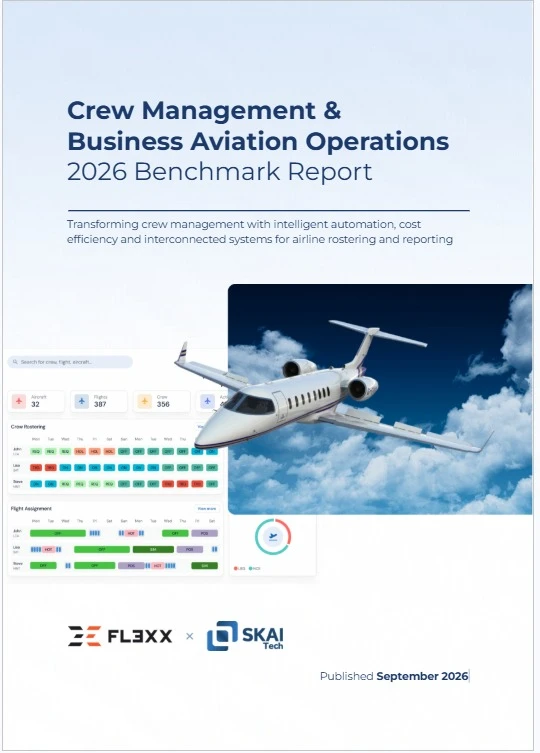
Why hand that arithmetic over at all? Because the search space is not on a human scale. The FL3XX × SkAI Tech Crew Management Benchmark 2026, a survey and analysis covering business aviation, puts a number on a deliberately tiny case: 14 flights and 10 crew members already allow 1.4 × 10²³ possible rosters. A planner evaluating 1,000 rosters a second would need 321 times the age of the universe to walk through them all. "Compares millions of solutions" is meant literally, and that capacity is what separates finding a roster that works from finding the best roster that works.
One misconception is worth clearing early: this is no black box making decisions in the operator's place. The rules are explicit and configurable; planners set the objectives and arbitrate edge cases. The arithmetic moves to the tool, while operating policy stays with the operator.
What exactly gets optimized?
A merely compliant roster is only a starting point. Between two legal rosters, quality is measured on four axes:
- Cost: deadheading, per diems and night-stops, lost block hours, reliance on extensions and reserve. This is where optimization shows up fastest — every night-stop avoided and every positioning leg removed comes straight off the operating budget.
- Robustness: a brittle roster amplifies every disruption. EUROCONTROL's CODA data for 2024 puts reactionary (knock-on) delay at 46% of European delay minutes, or 8.0 minutes per flight. Roster stability therefore acts directly on punctuality.
- Fairness and preferences: distribution of weekends, nights and layovers; honouring requests. In a pilot-shortage market this is a retention lever with a hard cash value.
- Reactivity: when everything is already modelled, re-generating after a disruption takes minutes. The literature also shows that integrated recovery (flights, aircraft and crew solved as one problem) outperforms the sequential approach on recovery costs (Petersen et al., 2012, Transportation Science).
What results should you expect?
Orders of magnitude, which every operator should validate on its own operation:
| Indicator | Before | With optimization |
|---|---|---|
| Monthly roster production | Days | ~12 minutes (SkAI observed average) |
| Roster deviations | Baseline | -20% (SkAI observed) |
| Replanning after disruption | Hours | Minutes |
| Direct flight coverage | Baseline | +21 percentage points |
| Duty days per pilot per month | Baseline | +0.42 day (capacity you already pay for) |
| Freelance duty days | Baseline | up to -40% |
| Duty spread between crew members | Baseline | -19% |
| Days-off requests granted | Baseline | +14% |
| Daily time spent on operations | Baseline | -1h30 per day |
The last six rows are the deployment results published in the FL3XX × SkAI Tech Crew Management Benchmark 2026, at business aviation operators. They carry the report's own caveat: results observed across SkAI Tech deployments in 2025-2026, varying with fleet size and operating model. They do not transfer to regional, ACMI or medevac operations.
At SkAI Tech these figures currently cover more than 70 aircraft planned and more than 900 crew members managed. All of it comes from live operations, not from a lab demo.
Do you have to replace your ops system to get this?
No. After the "black box" myth, this is the misunderstanding that stalls the most projects. Optimization does not require replacing the operations management system. SkAI Tech works as an API add-on: the existing system remains the source of truth for flights and crew; the platform reads that data, computes, and pushes the rosters back. No migration, no workflow change, which is the difference between a few-week project and an eighteen-month IT programme.
Jetfly made exactly this move, on top of FL3XX: read how Jetfly connected SkAI Tech to its ops system.
What should you ask a vendor?
- Which rules are encoded? ORO.FTL, Part 91/135, but also your internal and collective rules, and who maintains them when regulation changes.
- Add-on or replacement? What happens to your current ops system, and how long the integration really takes.
- What is optimized beyond feasibility? Cost, stability, fairness, and whether you can tune those objectives yourself.
- What happens on day-minus-one? Re-generation time after a disruption is the number that matters daily, far more than the demo on an empty month.
- What proof exists? References from operators like yours, with production figures.
To get past the sales narrative, the FL3XX × SkAI Tech Crew Management Benchmark 2026 sets out five things a modern rostering solution has to deliver. Each converts neatly into a demonstration you can ask for:
- A unified view of the problem: is the long-horizon roster evaluated in a single constraint context, or chopped into windows and stitched back together?
- Continuous feasibility evaluation: are problems surfaced early, before a disruption reveals them?
- Visibility on constraint margins: does the tool show how close to the limit each duty sits, or only whether it is legal?
- Propagation awareness: is a local change evaluated for its network consequences?
- Risk-based prioritisation: are problems ranked by operational impact, or listed flat?
FAQ
Will AI optimization replace crew planners?
No. It relocates their work. Hours crew planners spend building and checking grids shift to judgement: handling disruptions, special cases, anticipating training and recruitment needs. That is exactly what SkAI customers report.
How is this different from advanced Excel formulas or macros?
A spreadsheet macro checks rules row by row; an optimizer compares millions of complete rosters and selects the best. Verification says "this roster is legal"; optimization says "and it is the best legal roster against your objectives."
Our rules are unusual. Can a tool handle them?
That is selection criterion number one. A serious platform parameterises regional and in-house rules per operator, on top of the regulatory base (ORO.FTL, Part 91, Part 135 at SkAI).
Is our data safe in the cloud?
A fair question for any SaaS: require hosting and compliance that match your jurisdiction (for SkAI: data hosted in Paris, GDPR compliance).
Sources
- FL3XX × SkAI Tech, Crew Management & Business Aviation Operations 2026 Benchmark Report (August 2026): first-party data, business aviation scope, 30 operators surveyed.
- EUROCONTROL (2025), All-Causes Delays to Air Transport in Europe — Annual 2024 (CODA Digest), eurocontrol.int.
- Morabit, Desaulniers & Lodi (2021), Machine-Learning-Based Column Selection for Column Generation, Transportation Science 55(4), 815-831, DOI 10.1287/trsc.2021.1045.
- Yaakoubi, Soumis & Lacoste-Julien (2020), Machine learning in airline crew pairing to construct initial clusters for dynamic constraint aggregation, EURO Journal on Transportation and Logistics 9(4), DOI 10.1016/j.ejtl.2020.100020.
- Petersen, Sölveling, Clarke, Johnson & Shebalov (2012), An Optimization Approach to Airline Integrated Recovery, Transportation Science 46(4), DOI 10.1287/trsc.1120.0414.
- Deloitte (2025), CEO compass: Deloitte Global's 2025 Airline CEO Survey (32 CEOs surveyed, April-May 2025), deloitte.com.
- SkAI Tech KPIs (first-party data): generation time, deviation reduction and deployment results observed across 2025-2026 deployments, varying with fleet size and operating model.