Comparison
Excel vs crew scheduling software: when to make the switch
A spreadsheet is enough for crew scheduling as long as three things hold: a small crew list, few disruptions, and a planner who knows every rule by heart. Once rolling FTL limits, qualifications and last-minute changes pile up, the spreadsheet stops verifying anything: it only displays. That is when to switch.
Most mid-sized operators still build their rosters in Excel. Fair enough: at the start it is usually the right tool. The useful question is when Excel stops doing the job, and how to spot that point before an incident does it for you.
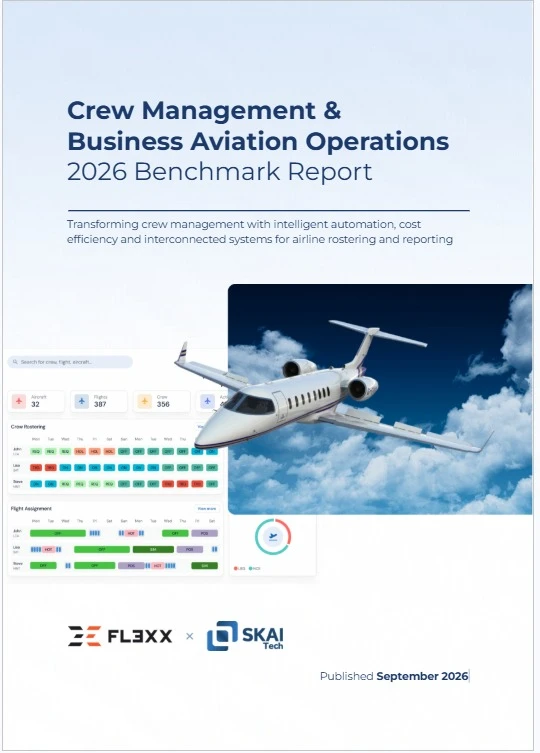
The FL3XX × SkAI Tech Crew Management Benchmark 2026, run with business aviation operators, puts numbers on where that point sits today. Across the 30 operators surveyed, rostering is already centralised (85% have a dedicated Ops/Crewing team), but for fleets of up to 15 aircraft that team is one to three people. The consequences: 81% describe their staffing as "stretched", 88% (close to nine in ten) spend significant time firefighting, and 85% are not "very confident" in their rostering process. None of that points to a competence problem. It points to tools that only show the margin once it has gone. These figures cover business aviation and do not transfer to regional, ACMI or medevac operations.
Why does Excel survive so long?
Because its strengths are real: total flexibility, zero licence cost, no training, and a layout each planner bends to their own way of working. For two or three aircraft and a dozen crew members, a well-kept spreadsheet in experienced hands produces perfectly decent rosters.
The problem is never what Excel displays but what it does not check.
Where does the spreadsheet break?
Rolling limits cannot be read off a grid
FTL ceilings (100 flight hours in any 28 days, 60 duty hours in any 7, a recovery rest every 168 hours; see our ORO.FTL guide) recompute at every assignment, in both directions of the calendar. A monthly grid shows neither the window that reaches back into last month nor the one that quietly makes a pilot unavailable next week. You can write formulas for some of it; nobody maintains all of it, and nobody trusts the file after six months of copy-paste.
Every disruption invalidates work already done
A delay, an AOG, a sick call: fixing one row in a spreadsheet re-checks none of the others. Every late change restarts the verification in the planner's head. Breaches happen exactly there: in the rush, patching the plan by hand.
The roster is a person, not a tool
The spreadsheet encodes one person's knowledge: their colour conventions, implicit rules, mental checks. When that person is on leave, resigns, or is off sick, the operator discovers the roster was never a system. It was them.
Crew requests never reach the file
The spreadsheet is never the only tool: a layer of messages orbits it. In the FL3XX × SkAI Tech Crew Management Benchmark 2026, about half of the 30 business aviation operators surveyed collect leave and preferences by phone, WhatsApp or email, with no structured system. Requests then arrive untimestamped, uncomparable and untraceable: the arbitration happens from memory, and it defends badly.
Structuring those requests does more than tidy them up: it makes visible what they say about staffing. Mathieu Leroi, Senior Crew Manager at Jetfly Aviation, puts it this way:
“SkAI Tech gives me alerts that I bring into our staffing meetings, so management can make the right calls: recruitment, fleet changes, better distribution across bases.”
No trail, no proof
In an audit, "the roster was compliant" has to be demonstrated. A spreadsheet logs neither who changed what nor what was checked. Scheduling software keeps the history and the justification behind every assignment.
Excel vs software: the comparison
| Criterion | Spreadsheet | Crew scheduling software |
|---|---|---|
| FTL checking | Manual / partial formulas | Systematic, at every assignment |
| Rolling windows (28 d, 168 h…) | Invisible | Continuously computed |
| Qualifications & expiry dates | Planner's memory | Blocking at assignment |
| Disruption response | Manual rework, mental re-check | Re-generation, compliance re-verified |
| Time to produce a roster | Days | Minutes (12 min observed average across SkAI Tech deployments, 2025-2026) |
| Key-person dependency | Total | Low: rules live in the tool |
| Traceability / audit | None | Full history |
| Optimisation (cost, preferences, fairness) | None: you look for a solution | You look for the best solution |
| Cost | "Free" (see below) | Subscription |
Excel's "free" is paid elsewhere: planner hours, roster deviations, avoidable positioning, lost flying and compliance exposure. None of those lines appears on an invoice, which does not stop them being paid every month.
What are the signs it's time to switch?
Three "yes" answers are usually enough:
- The monthly roster takes more than two days to build.
- Every disruption triggers hours of manual replanning.
- Only one person can really drive the file.
- You have already discovered an FTL breach after the fact.
- Crew requests (preferences, leave) arrive by phone, WhatsApp or email and get handled "when possible", with no visibility, as for about half of the 30 business aviation operators surveyed for the FL3XX × SkAI Tech Crew Management Benchmark 2026.
- The fleet or headcount is growing, or a new contract is landing (ACMI, charter season).
- An audit is coming and the roster's traceability worries you.
Does leaving Excel mean replacing your ops system?
No, and this misconception keeps more operators on spreadsheets than any technical reason does. Moving off Excel does not mean ripping out the operations system: SkAI Tech runs as an add-on, connected by API to the system already in place. Flight and crew data stay where they are; optimisation and compliance checking come on top.
Operators who made the switch report roster generation in about 12 minutes and 20% fewer roster deviations (observed across SkAI Tech deployments in 2025-2026; outcomes vary with fleet size and operating model). As the crew planning manager at Air Antilles puts it:
“The time savings are significant. We can now focus on specific adjustments, manage disruption, and better anticipate training and recruitment needs.”
Jetfly went through the same switch: read how Jetfly retired its Excel rosters.
FAQ
Is it illegal to roster crews in Excel?
No. Regulation mandates an outcome (compliant, demonstrable rosters), not a tool. The question is the risk and cost of getting there, not the legality of the spreadsheet.
Can we keep Excel at all?
Many operators still export rosters to a spreadsheet for distribution or ad-hoc analysis. What has to stop is the other direction: using the spreadsheet as the compliance check.
How long does the transition take?
Most of the lead time is connecting the data (flights, crew, qualifications). As an API add-on there is no system migration and no workflow change; the transition takes weeks rather than quarters.
At what fleet size does software pay off?
There is no magic aircraft count. The trigger is combinatorics: rules × crew × disruptions. A hard-working 5-aircraft charter operator can need it before a stable 10-aircraft scheduled fleet does.
Sources
- FL3XX × SkAI Tech, Crew Management & Business Aviation Operations 2026 Benchmark Report (August 2026): first-party data, business aviation scope, 30 operators surveyed.
- SkAI Tech KPIs (first-party data): generation time and deviation reduction observed across 2025-2026 deployments; outcomes vary with fleet size and operating model.
- Customer testimonials published on the SkAI Tech website (Jetfly Aviation, Air Antilles).
- EASA, Easy Access Rules for Air Operations — Part-ORO Subpart FTL, for the cumulative limits and recovery rest quoted above.