Comparison
Optimization add-on or all-in-one ops suite: which way for crew scheduling?
There are two routes to software-assisted crew scheduling: the scheduling module of an all-in-one operations suite, or a specialised optimization add-on connected by API to the system you already run. The suite consolidates everything in one place; the add-on brings optimization depth without a migration. The right choice depends on where you start from.
This comparison is written by an add-on vendor, better said upfront. But both models have legitimate use cases, and an informed choice beats a sales pitch. Here are the differences that actually matter, and the situations where each option wins.
What are we actually comparing?
- The all-in-one suite: a single system covering the whole of operations management (flights, quoting and sales, maintenance, documents, crew) with a scheduling module among its bricks. This is the model of the market's big aviation management platforms.
- The optimization add-on: a tool specialised in one problem, generating and optimizing rosters, that plugs into the existing operations system via API. The data (flights, crew, qualifications) stays in the incumbent system, which remains the source of truth; the add-on reads, computes, and pushes rosters back.
The classic misunderstanding is treating these as substitutes. An add-on presupposes an operations system, which it completes. The real alternative is: the suite's own scheduling module, or a specialised add-on on top of that same suite.
The honest comparison
| Criterion | Suite's scheduling module | Optimization add-on |
|---|---|---|
| Scope | All of operations management | Crew scheduling only |
| Optimization depth | Varies; often verification more than optimization | Core business: constraint-based generation and optimization |
| Data | Natively integrated | Read via API from the incumbent system |
| Implementation | Long if switching suites; zero if already equipped | Weeks: API integration, no migration |
| Project risk | High when migrating suites | Low; the existing system doesn't move |
| Team workflows | Change with the suite | Unchanged |
| Vendors | One | Two (suite and add-on) |
| Cost | Included or an extra module | Dedicated subscription |
Two nuances, for completeness:
- A single vendor is a genuine advantage of suites: one contract, one support channel, data consistency by construction.
- Scheduling modules differ widely: some check the compliance of a hand-built roster, others can generate one. The question to ask is the one from our AI roster optimization guide: does the tool look for a solution, or the best one?
How do you assess a scheduling module's depth?
This is the row that actually decides the choice, and the hardest to settle in a demo. The FL3XX × SkAI Tech Crew Management Benchmark 2026 sets out five things a modern rostering solution has to deliver, a grid that applies equally to a suite module and to an add-on. The report's own scope is business aviation, across 30 operators surveyed; the grid itself is segment-independent:
- A unified view of the problem: is the long-horizon roster evaluated in a single constraint context, or rebuilt window by window?
- Continuous feasibility evaluation: are problems surfaced early, before a disruption reveals them?
- Visibility on constraint margins: does the tool show how close to the limit each duty sits, or only whether it is legal?
- Propagation awareness: is a local change evaluated for its network consequences?
- Risk-based prioritisation: are problems ranked by operational impact, or listed flat?
A module that clears all five makes the add-on unnecessary, which is a perfectly acceptable conclusion. A module that clears one or two is doing verification, not optimization, and that is where the question of a complement arises.
When does the all-in-one suite win?
- You have no structured operations system yet: a suite is the right foundation, since an add-on with nothing underneath has nothing to optimize.
- Your priority is consolidating scattered tools (quotes, flights, maintenance, documents) more than optimizing the roster itself.
- Your scheduling problem is simple, with few crew and few disruptions, and the standard module genuinely covers it.
When does the add-on win?
- You are happy with your operations system: replacing it to improve scheduling alone is moving house to repaint one room.
- What you need is optimization depth: multi-contract ACMI, highly unpredictable charter, crew fairness, fast re-generation on disruption. These are the places where a generalist module runs out of road.
- You want short lead time and low risk: an API integration is measured in weeks and changes nothing in your teams' workflows.
That is SkAI Tech's model, and our own FAQ puts it plainly: it "works as an add-on" and is "not a replacement to your operations management system". Architecturally, that means your FMS stays the source of truth for flights and crew; the add-on reads that data via API, optimizes under constraints, and pushes rosters back to the system in place. Observed across SkAI Tech deployments in 2025-2026, the model delivers an average generation time of 12 minutes and 20% fewer roster deviations, with outcomes varying by fleet size and operating model.
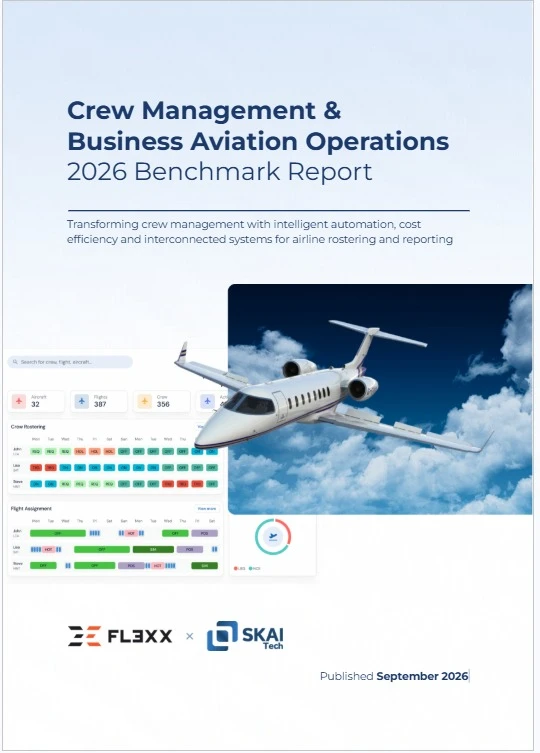
There is a public artefact of the same model. The Crew Management & Business Aviation Operations — 2026 Benchmark Report, published in August 2026, is co-signed by FL3XX and SkAI Tech: two separate vendors publishing together and answering jointly for the same scope in front of the same customers. That proves nothing technically, but it is the most practical signal of what an integration is worth. Vendors who commit publicly together do not pass support tickets back and forth, and that speaks directly to the "two vendors" row above.
Already running FL3XX, Cyberjet or Leon? See how SkAI Tech connects to your ops system.
FAQ
Doesn't an add-on duplicate my suite's scheduling module?
They overlap on display, not on computation. If your module is where you visualise and verify, the add-on adds generation and optimization. If your module already optimizes at the depth you need, an add-on isn't justified. That's a genuine decision criterion, not false modesty.
What if I switch suites later?
That is an advantage of the add-on model: the optimized scheduling comes with you, and only the API integration needs redoing. A roster capability locked inside a suite migrates with the suite.
Two vendors: isn't that twice the problems?
It is the cost of the model, and worth stating plainly. It is managed contractually (clear responsibility boundaries) and through integration quality, which is why native integrations maintained by the add-on vendor beat ad-hoc connectors. A usable test is how far the two vendors commit together in public: a co-signed publication, such as the FL3XX × SkAI Tech 2026 benchmark, says more than an "integration available" line on a product page.
What if I'm still on Excel, with neither suite nor add-on?
Start with our Excel versus crew planning software comparison: step one is a clean data source (an ops system, or at minimum structured data). Optimization comes after.
Sources
- FL3XX × SkAI Tech, Crew Management & Business Aviation Operations — 2026 Benchmark Report (August 2026): co-signed publication, 30 business aviation operators surveyed, five-point evaluation grid.
- SkAI Tech FAQ (add-on positioning) and the Integrations and API page of this site, for how the integration works.
- Results observed across SkAI Tech deployments in 2025-2026 (first-party data): 12-minute average generation time, 20% fewer roster deviations; outcomes vary with fleet size and operating model.