Operations
The pilot shortage in business aviation: why rostering comes before hiring
The global pilot shortage has eased, according to Oliver Wyman's latest analysis. The strain on business aviation operators has not: 81% describe their staffing as stretched and three in four rely on freelance crew. The problem has changed shape: it is less about how many pilots the market holds than about what they cost and how well you fly the ones you already have. That is where rostering works, faster than hiring.
The shortage story is old; its shape is new. Hiring is still slow and expensive, but the sharper question is how to fly the crew you have without wearing them out, when every resignation takes months to replace. That is where crew rostering stops being administration and becomes a capacity decision.
Is there still a pilot shortage?
Separate what the projections said, what they say now, and what has not gone away.
The projections have been revised down. The most-quoted numbers come from Oliver Wyman. In January 2023 it expected the North American gap between pilot supply and demand to peak at around 24,000 in 2026, narrowing to 17,000 by 2032; by October 2023 it had cut the projected 2032 shortfall by 23%, to about 13,300 pilots. Its late-2025 brief goes further: its year-end 2024 forecast now has global pilot supply outpacing demand through the rest of the decade, with only the Middle East still facing a shortage. An article announcing “24,000 pilots short in 2026” today would be quoting a projection its own author has moved on from.
The cost has not gone away. The October 2023 analysis recorded captain pay at US mainline carriers up 46% since 2020, and up 86% at US regionals. The 2025 brief finds pilot costs still outpacing airlines' total cost growth. For a business aviation operator, two things follow: hiring costs more, and keeping people gets harder, because the alternative pays better.
The fleet to crew keeps growing. According to GAMA, 383 business jets were delivered in the first half of 2026, up 8.2% year on year, with total airplane billings of $14.3 billion (+15.5%). Every delivered airframe needs crew rated on its type.
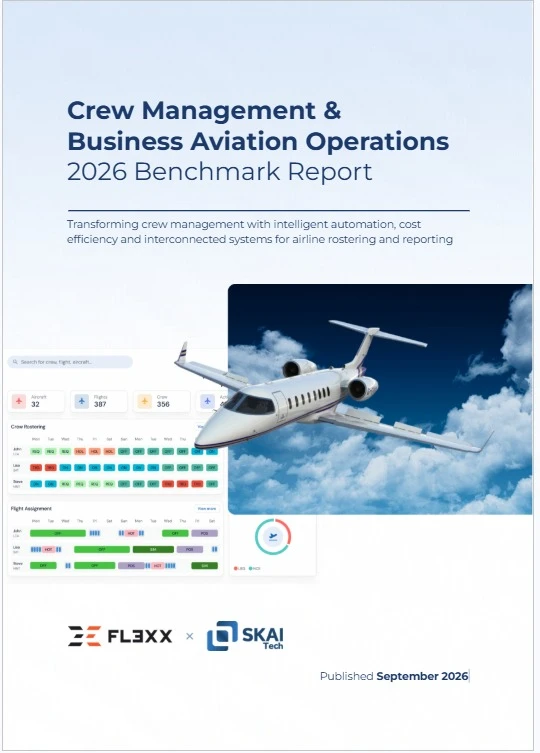
And inside the segment, the strain is measurable. In the FL3XX × SkAI Tech Crew Management Benchmark 2026, across the 30 business aviation operators surveyed, 81% describe their staffing as stretched and three in four use freelance or contract crew, with one in two calling that a stopgap rather than a strategy. The reasons are explicit: 35% use it as a bridge while a hire or a type course completes, 31% out of straight necessity after a qualification gap or an unplanned departure. The shortage operators feel is no longer an empty market. It is a shortage of qualified, available pilots in the right place at the right time.
Why is business aviation still exposed?
A twelve-pilot flight department is not a small airline. Its exposure is different in kind.
- The team is too small to absorb a departure. Across 900 crew members, one resignation is noise. Across twelve, it is 8% of capacity, usually with a qualification that cannot be covered internally. In business aviation, a shortage is felt tail by tail.
- Qualifications are narrow. One type rating, sometimes one airframe, specific authorisations (demanding airports, long-range operations), visas. An available pilot is not always an assignable pilot.
- Demand is irregular. Missions arrive as quotes, days or hours out. Headcount sized for the peak destroys the operator's economics; headcount sized for the trough turns flights away.
- The competition for crews is asymmetric. Airlines offer pay scales and a roster published well in advance. Business aviation offers more varied flying, often with less predictability. That difference, as much as pay, is what decides resignations, and it is the one rostering controls directly.
What can rostering actually do about a shortage?
Rostering does not create pilots. It moves three things, and it is worth being precise about which.
It surfaces capacity you already have
In operations planned by hand or in a spreadsheet, part of the capacity disappears without ever being seen: a crew member locked up by an assignment another could have taken, avoidable positioning, ON days spent on missions someone else covered better, safety margins taken twice because nobody can check the rolling FTL counters precisely enough.
None of that appears on a dashboard; it surfaces in the flights you decline. An assignment engine that chooses by looking at the whole roster, rather than just today's mission, recovers it. The benchmark sizes that recovery: across SkAI Tech deployments, direct flight coverage rises by 21 percentage points, by releasing +0.42 duty days per pilot per month. Those are days already paid for, already legal, and simply unreachable when assignment is decided one mission at a time. The effect lands on the most expensive line of a shortage, bought-in capacity: up to 40% fewer freelance duty days. These results were observed across 2025-2026 deployments and vary with fleet size and operating model: an order of magnitude, not a commitment.
This is the most useful answer to “should we hire?”: find out how much capacity the current organisation is leaving on the table before adding to it.
It gives planning time back to the work that fixes the shortage
A monthly roster built by hand takes days, and every disruption claws part of it back. That time is taken from the work that actually addresses a shortage: anticipating training needs, preparing missing qualifications, following up candidates.
At operators running SkAI Tech, average roster generation time is 12 minutes. Air Antilles' crew planning manager puts it this way:
“The time savings are significant. We can now focus on specific adjustments, manage disruption, and better anticipate training and recruitment needs.”
It keeps the crews you have
This is the most underrated effect, and the most durable. Pilots rarely resign over one hard trip. They resign over accumulation: OFF days pulled back repeatedly, leave refused without explanation, the sense that the unpleasant assignments always land on the same people. Every one of those is a rostering decision.
A predictable, fair roster does not offset a 46% pay gap, and pretending otherwise would be dishonest. But it moves the threshold at which a pilot who likes the job starts taking calls. For a flight department, keeping two pilots a year is worth more than one successful hire.
How do you get ahead of it instead of reacting?
Measure true availability, not headcount
Contracted headcount says nothing about flying capacity. Between the two sit rolling FTL counters, upcoming rest, qualification expiry dates, leave, training, visas. The only useful figure is true availability, computed at a point in time for a given mission (see our guide to charter crew rostering). It is what should answer commercial requests, and the only way to say whether you are short of pilots or short of organisation.
See qualification gaps coming
A qualification expires on a known date, and training can be scheduled. Yet in many operations the expiry is discovered at assignment time, and the trip goes out short-crewed or sub-optimally crewed. Tracking validity in the same tool that makes assignments turns a risk into a calendar.
Size the team by simulation
“How many pilots do I need?” is a simulation question. Given a mission profile, ON/OFF patterns and the applicable rules, you can compute the coverage a given headcount produces, and the headcount a target coverage requires. Our crew sizing calculator gives a first order of magnitude. It is the only way to defend a hiring budget with something other than conviction, or to show that no hire is needed.
Cut deviations instead of compensating for them
Every gap between the published roster and the flown roster is paid twice: once in immediate rework, once in credibility with the crews. Operators running SkAI Tech report 20% fewer roster deviations, a number to read first as a people metric, then as an operational one.
Does this require replacing the ops system?
No, and that matters for departments whose ops team fits in one room. The data already exists in the operations system: flights, crew, qualifications. What is missing is the engine: compliant roster generation, true-availability computation, optimised assignment.
SkAI Tech runs as an add-on connected by API to the system already in place (native FL3XX integration, plus CyberJet): the existing system stays the source of truth and team workflows do not change. Our add-on vs all-in-one suite comparison sets out the trade-offs.
Weighing a hire against better rostering? See what SkAI Tech changes for operations leaders.
Where do you start if you are already short-crewed?
In this order, because the order matters:
- Establish true availability for the next 90 days, qualification by qualification. Part of every perceived shortage turns out to be a distribution problem.
- List last quarter's recurring deviations and their causes. The same causes come back almost every time.
- Protect OFF days before anything else. It is the first retention factor and costs nothing but rostering discipline.
- Map qualification expiry dates across twelve months, so gaps stop being discovered at assignment time.
- Tool the assignment decision before tooling anything else: that is where hidden capacity is recovered.
- Then size the hiring need with the model you now have, and not before.
FAQ
Is the pilot shortage over?
Globally, Oliver Wyman's latest forecast (year-end 2024, published in 2025) has pilot supply outpacing demand through the rest of the decade, outside the Middle East. But the pay increases are locked in, and the business aviation operators surveyed for the 2026 benchmark remain stretched on qualified, available pilots. The market shortage is receding; the operational strain is not.
Can better rostering really replace hiring?
It can delay it, shrink it, or remove the need entirely when the real problem was distribution. The documented order of magnitude is +21 percentage points of direct flight coverage across SkAI Tech's 2025-2026 deployments, with outcomes varying by fleet size and operating model. It cannot replace hiring when capacity is genuinely missing, which is why measuring comes before concluding.
How long before it shows an effect?
The capacity effect (optimised assignment, planning time) shows within the first roster cycles. The retention effect takes several quarters: it depends on consistency, not on a one-off change.
How do you measure rostering's effect on retention?
Three metrics are enough to start: the share of published OFF days actually honoured, the spread of workload between crew members holding the same qualification, and average response time to leave requests. All three are available in a rostering tool, and all three track the sense of fairness.
Should we raise pay or improve the roster?
The two levers act at different moments in a pilot's decision. Pay matters at hiring and at career turning points; roster quality matters daily, and it decides whether a pilot listens to an offer at all. Improving the roster is also the faster lever to pull.
Sources
- FL3XX × SkAI Tech (2026, August), Crew Management & Business Aviation Operations — 2026 Benchmark Report: survey of 30 business aviation operators (stretched staffing, freelance reliance and its reasons).
- SkAI Tech deployment results 2025-2026, quoted with the report's caveat: results observed across these deployments, varying with fleet size and operating model.
- General Aviation Manufacturers Association (2026, 3 September), Second Quarter 2026 Aircraft Shipment and Billing Report: 383 business jets delivered in the first half of 2026 (+8.2%), $14.3 billion in airplane billings (+15.5%).
- Oliver Wyman (2023, January), Industry Efforts Are Easing Pilot Shortage Severity: widest gap of about 24,000 pilots in 2026, 17,000 by 2032, North America.
- Oliver Wyman (2023, October), North American Pilot Shortage Shows 23% Smaller Gap In 2032: projected shortfall of about 13,300 pilots in 2032; captain pay up 46% (US mainline) and 86% (US regionals) since 2020.
- Oliver Wyman (2025), Meeting The Wave — Shifting Global Pilot Careers: global pilot supply projected to outpace demand through the rest of the decade, outside the Middle East; pilot costs outpacing total cost growth.
- SkAI Tech indicators (first-party data): average generation time and reduction in roster deviations observed across 2025-2026 deployments.