Operations
Crew leave planning without breaking coverage
Crew leave planning means spreading absences across the year so that as many requests as possible are granted without ever dropping below the minimum coverage required at each base and for each qualification. Handled one by one as they arrive, requests open coverage holes; allocated across the whole year as an optimisation problem, they become a retention lever.
Leave is often treated as administration: a queue of requests, case-by-case arbitration, a spreadsheet kept current. That sequential treatment is precisely what produces the year-end crunch, followed by expensive overtime in peak season.
Why does first-come-first-served fail?
Three structural flaws:
- Early requests consume later capacity. Granting a request without a view of the full year is deciding blind: the remaining capacity only becomes visible afterwards, usually at the worst moment.
- Coverage is not measured in headcount. Three available pilots do not replace one absent colleague if they are not rated on the right type or not assigned to the right base. The real constraint is coverage per base and per qualification, not total headcount.
- Regulatory rest is not leave. The recovery rest imposed by regulation is an obligation, not a favour. Keeping it in the same spreadsheet as annual leave creates the illusion of a flexibility that does not exist.
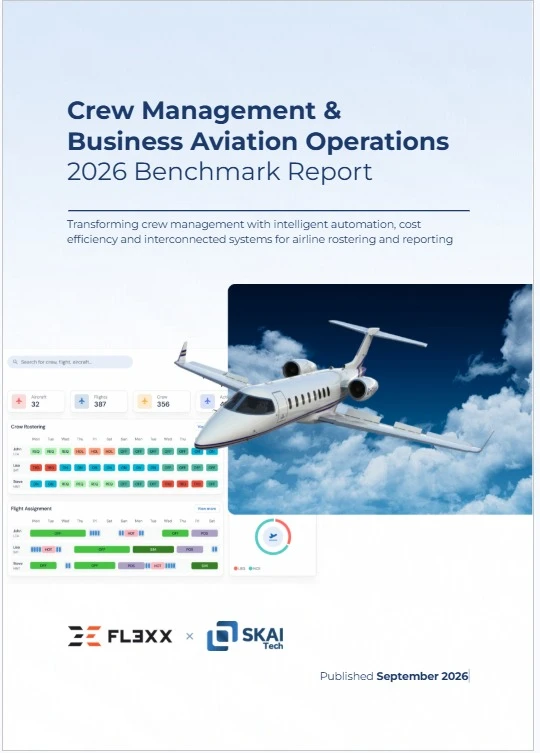
The starting point is often more artisanal still: per the FL3XX × SkAI Tech Crew Management Benchmark 2026, about half of the 30 business aviation operators surveyed collect leave and preferences by phone, WhatsApp or email, with no structured system.
Leave, days off and recovery rest: what's the difference?
Three obligations share the same calendar without coming from the same text. Mixing them up distorts absence capacity before the first request is even in.
| Obligation | What it requires | Where it comes from |
|---|---|---|
| Paid annual leave | At least four weeks a year, on the conditions set by national law; cannot be replaced by an allowance in lieu, except when employment ends | Directive 2000/79/EC, clause 3, then national law and collective agreements |
| Days free of all duty and standby | At least 7 local days per calendar month and 96 per calendar year, notified in advance, on top of annual leave; they may include rest periods required by law | Directive 2000/79/EC, clause 9 |
| Recurrent extended recovery rest | At least 36 consecutive hours including 2 local nights, never more than 168 hours apart, extended to 2 local days twice a month | ORO.FTL.235, for commercial air transport by aeroplane |
Recovery rest can therefore count among the days off, never as leave. The directive sets a European floor that each Member State has transposed and that collective agreements often raise: actual entitlements are checked against the applicable national law and agreement. Recovery rest is covered in detail in our EASA FTL rules guide; air taxi, EMS and single-pilot operations currently follow national rules.
How should the problem be framed?
A leave plan is built from minimum coverage, not from the requests. The useful sequence:
- Establish coverage demand across the year: by base, by qualification, month by month, reflecting the seasonality of the programme.
- Derive absence capacity: how many crew can be away at the same time, on each segment, without breaching the threshold, keeping a margin for absences that cannot be planned (sickness, catch-up training).
- Optimise the allocation under that constraint: grant as many requests as possible, resolving conflicts through rules published in advance (seniority, rotation of popular periods, balancing of refusals).
- Hold capacity back for late requests: a plan that consumes all absence capacity in the annual campaign leaves nothing for personal emergencies, and generates refusals that feel arbitrary all year round.
Why is this an optimisation problem?
Because requests are interdependent. Refusing one request can unlock three others; shifting a week can save an entire period. Sequential handling never sees these trade-offs: it approves or refuses locally, without knowing what the decision costs overall.
An optimisation engine compares complete leave plans. At identical coverage it finds combinations that grant more requests than manual arbitration does, with no particular subtlety involved: it simply tries vastly more combinations. The mechanism is the same as in roster optimisation, where a planner stops at the first acceptable solution while the algorithm works through the whole set and keeps the best one.
What this changes for retention
How leave is allocated is one of the subjects crews watch most closely. Three practices make the difference, and all of them require reasoning across the whole plan:
- Rules known in advance, rather than arbitration that reads as discretionary;
- Balancing refusals over time: whoever lost the arbitration this year should have priority next year;
- Fast answers: a request left pending for weeks erodes trust far more than a prompt, explained refusal does.
At identical coverage, optimisation also grants more: across SkAI Tech deployments in 2025-2026, +14% of requested days off granted (business aviation scope; outcomes vary with fleet size and operating model; FL3XX × SkAI Tech Crew Management Benchmark 2026).
That is how rostering works in SkAI Tech: ON and OFF days are distributed around holidays, rest preferences and training, with the right number of crew on each day, and the roster is re-generated in 12 minutes on average when a request changes the picture. Anticipating coverage better also means anticipating training and recruitment better, as the crew planning manager at Air Antilles puts it: “The time savings are significant. We can now focus on specific adjustments, manage disruption, and better anticipate training and recruitment needs.”
Rostering for a scheduled airline? See how SkAI Tech builds network rosters around crew leave.
FAQ
Should the leave plan be locked once agreed?
No. An annual plan is a baseline, not a carved contract. What matters is knowing, at each change, whether coverage still holds. That requires being able to recompute, not redoing everything by hand.
How do you arbitrate the most popular periods?
Through explicit, stable rules (seniority, year-on-year rotation, quotas per period), published before the campaign opens, as in a crew bidding process. The tool applies the rule; deciding it remains a management call, and that division of labour is the right one.
Leave versus recovery rest: what's the difference?
Recovery rest is a regulatory, fatigue-driven obligation with an imposed frequency: 36 hours including two local nights, never more than 168 hours apart, under ORO.FTL. Annual leave falls under employment law and the applicable agreements, with a European floor of four paid weeks. Both occupy the calendar, but only the second is negotiable.
How many crew can be on leave at the same time?
There is no universal figure: the answer is computed base by base and qualification by qualification, from programme coverage, the reserve to hold and the absences that cannot be planned. For a fleet-level order of magnitude, our crew sizing calculator includes annual leave in the calculation.
Sources
- Council Directive 2000/79/EC of 27 November 2000 concerning the European Agreement on the Organisation of Working Time of Mobile Workers in Civil Aviation (OJ L 302, 1.12.2000): clause 2 (mobile staff in civil aviation), clause 3 (paid annual leave of at least four weeks), clause 9 (days free of all duty and standby).
- Regulation (EU) No 965/2012, Annex III (Part-ORO), Subpart FTL: ORO.FTL.235 (rest periods, recurrent extended recovery rest), and Article 8 for the operations left to national rules.
- FL3XX × SkAI Tech (2026, August), Crew Management & Business Aviation Operations 2026 Benchmark Report: first-party data, 30 business aviation operators surveyed (collection of leave and preferences); 2025-2026 deployment results (requested days off granted), varying with fleet size and operating model.
- Customer testimonial published on the SkAI Tech website (Air Antilles).
- National employment law and the collective agreements applicable to the operator, which set actual leave entitlements.