Operations
Managing on-demand flights without burning out your crews
In on-demand flying, uncertainty wears crews down faster than hours do. An ON day announced then cancelled, an OFF day taken back the night before, a standby that is never acknowledged as work: each costs more than a heavy but predictable schedule, and rostering can address all three.
A business aviation operator does not get to choose regularity; the market does not offer it. What the operator does choose is what it guarantees crews despite the irregularity. That choice is made when the roster is built, well before anyone's goodwill comes into play.
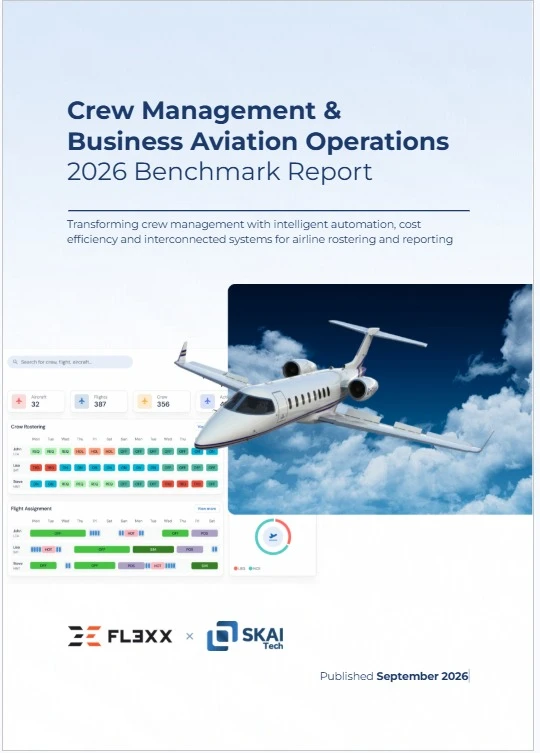
The FL3XX × SkAI Tech Crew Management Benchmark 2026 frames the same point sharply: "What separates operators is therefore not how often disruption arrives, but how much of it their roster can absorb. The same sick call is a non-event for an operation with slack, and a cancelled charter for one without." Two operators flying the same programme through the same disruptions do not have the same month. The difference is the slack the roster carries, and slack is a construction decision taken long before the disruption arrives.
The same survey also locates where those disruptions come from, and it is people rather than machinery: 77% of the 30 business aviation operators surveyed name human factors (sickness, fatigue, last-minute unavailability) as the leading driver of unplanned changes, ahead of weather and maintenance. A roster that wears crews down is therefore feeding the disruption flow it will have to absorb next month.
What actually wears an on-demand crew down?
Three mechanisms, usually collapsed into "workload".
Uncertainty about private life. A pilot who cannot plan anything two weeks out does not fully rest on OFF days; they stay mentally on call. That cost never appears in an FTL counter, but it is real and it accumulates.
Reclaimed OFF days. Every OFF day pulled back to cover a trip reads, from the crew's side, as a broken commitment. An operator can afford that twice a year. At the same rate every month, it is training its own leavers.
Perceived asymmetry. When night trips, callouts and long absences from home land consistently on the same people (usually the most available, or the least vocal), the sense of unfairness sets in faster than physical fatigue. It bears directly on retention, which we cover in our article on the pilot shortage in business aviation.
Regulatory limits (flight and duty time, minimum rest, the low-performance night window), whether under ORO.FTL or under the national rules that still govern air taxi, address immediate fatigue risk. They address none of the three mechanisms above: a fully compliant roster can still be structurally exhausting.
How do you protect OFF days when trips land the day before?
By separating explicitly what is guaranteed from what is open.
That is the point of ON/OFF patterns: crews know which days they can be called on and which they cannot, even though the content of ON days stays unknown until the last moment. Uncertainty is concentrated where it is unavoidable, and removed from everywhere else.
Three rules make the principle credible:
- A published OFF day is an honoured OFF day. If an exceptional callout procedure is needed, it must be written, compensated, rare. And counted.
- Callouts are a measured event. If they appear nowhere, they become invisible to management and omnipresent to crews.
- Capacity has to come from somewhere else. If coverage only holds because OFF days get reclaimed, the problem is not this month's roster but how the reserve is sized.
Is standby rest or work?
This is the segment's most poorly handled question. An unstructured standby feels like a working day to the crew member while counting as an available day to the operator.
A usable standby is defined by four parameters: its duration, its response time (home standby, airport standby), its pay or compensation, and its effect on rest once activated. Until those four are explicit, you are not rostering a reserve. You are maintaining an ambiguity that gets expensive in human terms.
Two frequent mistakes: sizing the reserve by instinct ("one extra crew at weekends"), and rotating standby duty in the same order every time. Standby rotation is a fairness problem as much as a coverage problem.
How do you share the load fairly?
Fairness is not strict equality: two crew members with different qualifications do not fly the same things. It is built on measurable quantities, tracked over time.
| Dimension | What you measure |
|---|---|
| Load | Flight hours and ON days per crew member, over 30 and 90 days |
| Hardship | Night sectors, nights away from base, long rotations |
| Callouts | Number of OFF days reclaimed, per crew member |
| Requests | Acceptance rate for leave and preferences |
| Peer group | Compared within the same qualification, not fleet-wide |
None of these are hard to produce; they all live in the rostering data. What is hard is using them while building the roster, instead of discovering them in an annual review. An optimisation engine does this natively: fairness becomes an objective of the computation, alongside coverage.
How much room should crew preferences get?
Explicit and bounded room. The worst model is "where possible": requests handled case by case, with no visible rule, producing an outcome that feels arbitrary even when it is balanced.
A sound model rests on formalised requests (dates, priority), a known arbitration rule for conflicts, and a per-crew satisfaction rate. Optimisation can carry preferences as a secondary objective, after compliance and coverage. Crucially, it can also show crews what was granted and why.
How do you spot burnout before it shows?
Four early signals, all available in a rostering tool:
- the rate of reclaimed OFF days rising month over month;
- concentration of hard trips on a small number of crew members;
- a widening gap between the published and the flown roster, which SkAI Tech also tracks as its deviation metric;
- a falling leave acceptance rate, often the very first sign.
Fast roster re-generation changes what you can do about those signals: when rebuilding a compliant roster takes about twelve minutes instead of days, correcting an imbalance stops being a painful trade-off. That is what SkAI Tech brings business aviation operators, as an add-on connected by API to the operations system already in place, with an average generation time of 12 minutes and 20% fewer roster deviations at equipped operators. Those results are observed across SkAI Tech deployments in 2025-2026, over a scope of more than 70 aircraft and 900 crew members, and vary with fleet size and operating model.
The measured effect lands first on imposed workload. Across the same deployments, the benchmark reports 15% fewer extra duty days, meaning fewer duties added to the roster after publication, a 19% smaller duty spread between crew members and 14% more days-off requests granted. These are workload and fairness metrics, not a clinical fatigue measurement. But they close the loop opened earlier: less imposed duty means less exposure to what drives human unavailability, and so fewer disruptions to absorb next month.
Flying on demand? See how SkAI Tech works for non-scheduled operators.
FAQ
How do you give visibility when the flights are unknown?
By guaranteeing OFF days and rest rather than missions. Business aviation crews handle uncertainty about the content of their ON days well; they handle uncertainty about their days off far less well.
Do we need to hire to stop calling crews back?
Not necessarily. First check whether callouts come from missing capacity or from poor assignment upstream. Calculating true crew availability settles that question.
Should standby be rostered like a duty?
Yes, with a defined duration, response time and compensation. An implicit standby is counted as availability by the operator and lived as work by the crew member: that is a structural misunderstanding, not a detail.
Do crew preferences hurt performance?
No, as long as they stay a secondary objective behind compliance and coverage. An optimisation engine handles several objectives at once: including preferences does not degrade coverage, it consumes slack that already existed.
Sources
- FL3XX × SkAI Tech (2026, August), Crew Management & Business Aviation Operations 2026 Benchmark Report: first-party data, 30 business aviation operators surveyed (drivers of unplanned changes), and outcomes observed across SkAI Tech deployments in 2025-2026 (extra duty days, duty spread between crew members, days-off requests granted).
- Regulation (EU) No 965/2012, Annex III, Part-ORO, Subpart FTL: flight and duty time limitations and rest requirements; Article 8(2) for the air taxi derogation to national rules.
- SkAI Tech KPIs (first-party data): average generation time and deviation reduction observed across 2025-2026 deployments, varying with fleet size and operating model.