Research
Freelance crew in business aviation: safety net or rostering symptom?
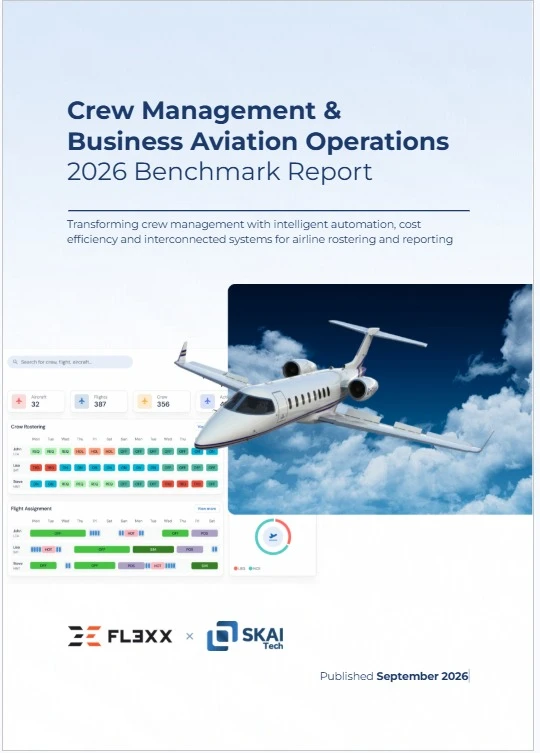
Three in four business aviation operators use freelance crew, and for one in two it is a stopgap rather than a strategy, according to the FL3XX × SkAI Tech Crew Management Benchmark 2026. Freelance capacity has genuine uses. The problem starts when it fills gaps a better-built roster would have absorbed.
Freelance crew is one of the few planning decisions that lands directly in the accounts: an external charge, mission by mission. The benchmark makes it possible to tie that line back to its cause, and to separate the share that reflects a deliberate operating choice from the share that reflects a roster that did not hold.
How widely is freelance crew used in business aviation?
The FL3XX × SkAI Tech Crew Management Benchmark 2026, a survey of 30 business aviation operators running from fewer than 5 to more than 30 aircraft, finds that three in four use freelance or contract crew. At that level, this is no exceptional emergency measure: it is part of how the segment ordinarily operates.
The same benchmark qualifies that use: for one operator in two, freelance crew is a stopgap rather than a strategy. Two reasons dominate.
| Stated reason | Share of operators |
|---|---|
| "Operational bridge": recruitment or training in progress | 35% |
| "Resource necessity": shortage or unplanned departure | 31% |
Both answers describe the same situation from two angles. In the first, the resource is coming but has not arrived; in the second, it does not exist, or no longer does. Neither describes freelance capacity chosen for what it brings. It gets taken on to cover what is missing.
When is freelance crew the right tool?
The opposite shortcut is tempting, so it needs saying plainly: using freelance capacity is not a failure in itself. Several uses are rational and will remain so, however good the roster gets.
- Seasonal peaks. Demand concentrated into a few weeks (winter season, major events, holidays) does not justify sizing permanent headcount to the annual maximum. Paying for twelve months of capacity to use two is a bad trade, however fine-tuned the roster.
- Rare qualifications. A thinly represented type in the fleet, a specific rating, a particular approval: keeping in-house a competence needed a handful of times a year, with its recency requirements, can cost more than buying it per mission.
- A genuine recruitment bridge. A freelancer covering the six weeks between a departure and the arrival of a replacement who has already signed is doing exactly the right job. That is what "operational bridge" should mean: a bridge has two banks, and the far one is known.
- Opening a base or a market. Until volume stabilises, variable capacity is more prudent than fixed headcount.
In all four cases the decision is made in advance, for an identified reason, over a bounded period. That is what separates a management instrument from a stopgap.
Why does one operator in two call it a stopgap?
Because in those cases the trigger is neither seasonal, nor technical, nor planned: it is a hole that opened up two weeks, or forty-eight hours, before departure. The benchmark describes the ground on which those holes form:
- 88% of operators spend significant time firefighting: 65% split their energy between planning and reacting, 23% are firefighting full time;
- 81% describe their staffing as "stretched";
- 77% name human factors as the leading driver of unplanned changes;
- roughly half collect leave and preferences by phone, WhatsApp or email, with no structured system.
Put together, these produce a recognisable sequence. The roster is built tight, because there is no way to compare alternatives: 14 flights and 10 crew members already produce 1.4 × 10²³ possible rosters (see our article on the combinatorial explosion). Someone becomes unavailable, human factors being the leading driver of change. There is no slack where slack was needed, because slack was never an explicit objective. A few days out, the only lever that produces a qualified crew member immediately is the market. Freelance capacity sits at the end of that chain, the fire exit for a problem that started much earlier.
The report also brings to light the shock absorber that often comes before freelance: in smaller organisations, it can be the executive who simply flies more when a pilot is missing. That works up to a certain volume; beyond it, the bill goes outside.
What does a freelance day actually cost?
The report publishes no rates, and this article will not put one forward. The cost structure, however, is worth setting out, because it is easily understated when the decision is made under time pressure:
- The day rate, which pays for immediate availability and the absence of any long-term commitment.
- Positioning. Freelance crew are rarely where the aircraft is. The positioning leg consumes time, a ticket, sometimes a hotel night, even a billed day with no flying on it.
- Supervision time. Briefing, system access, company procedures, checking qualifications and recency: all of it comes out of a crewing team that the benchmark describes as 1 to 3 people for fleets of up to 15 aircraft.
- The invisible substitution cost. This is the one that gets forgotten, because it appears on no invoice: while a freelancer covers a flight, capacity you already pay for may sit unused elsewhere in the roster, because nothing made it available.
The price of availability also tracks the price of pilots. Per Oliver Wyman (October 2023), captains' pay has risen 46% since 2020 at major US airlines and 86% at US regionals. That is a North American, scheduled-airline scope, and the firm has since revised its shortage projections downwards; the pay rises, however, are here to stay (see our article on the pilot shortage in business aviation). A stopgap whose reference price keeps climbing is all the more expensive to let become structural.
How much capacity is already sitting inside payroll?
The results below come from the report, observed across SkAI Tech deployments in 2025-2026, and vary with fleet size and operating model:
- +21 points of direct flight coverage, achieved by releasing +0.42 duty days per pilot per month;
- freelance duty days down by up to 40%;
- −19% duty spread between crew members and +14% more requested days off granted: the recovered capacity is not paid for in fairness;
- −15% additional duty days, so less load on crew, when human factors are the leading driver of unplanned changes.
The +0.42 duty days per pilot per month helps read the 40%. Less than half a day per crew member per month, a margin nobody notices at individual level, goes hand in hand with twenty-one extra points of direct coverage. The capacity was there all along; it sat in the wrong place in the calendar, behind assignments built one at a time instead of compared against each other.
The report puts it in one line: “The most expensive aircraft is the one sitting on the ground for lack of crew. SkAI Tech releases capacity you already pay for.”
Is your freelance usage chosen or forced?
Four questions settle it, and all four can be answered from data already in the operations system:
- How much notice? A mission committed three weeks out belongs to a capacity plan. One committed forty-eight hours out signals a coverage failure.
- How recurrent? Usage concentrated in two months of the year is seasonal; spread across twelve months, it is structural. And structural usage without a structural reason is a stopgap.
- What competence? If the freelancer brings a rating nobody holds in-house, you bought a competence. If they do exactly what your own crew do, you bought availability. And availability can be planned.
- What was internal utilisation on the same day? This is the decisive test. If contracted crew were off or unassigned on the day a freelancer flew, the problem lies in how the roster was built, not in the freelance rate.
Running that diagnostic does not require changing systems. SkAI Tech connects as an API add-on to the operations platform already in place, FL3XX among them, which remains the source of truth for flights and crew: the platform reads that data, builds rosters and writes them back. Operators running it generate a complete roster in 12 minutes on average and see 20% fewer roster deviations. Those results are observed across 2025-2026 deployments, over a scope of more than 70 aircraft and 900 crew members, and vary with fleet size and operating model.
How do you cut usage without losing coverage or fairness?
The evaluation framework set out in the report gives the principles:
- Make margins visible before they run out. The report calls it visibility on constraint margins: knowing how close each activity sits to its limit is knowing where an absence will be absorbed and where it will cost a mission.
- Evaluate feasibility continuously, not at publication. A problem found twenty days out gets solved with internal crew; the same problem two days out gets solved on the market.
- Treat fairness as a constraint, not a consequence. The +14% days off granted and the −19% duty spread show that using internal capacity better does not mean loading the same few people, which would simply swap a freelance invoice for a retention risk.
Responsible for the crew budget? See how SkAI Tech releases capacity you already pay for, for operations leaders.
FAQ
Should operators stop using freelance crew?
No. Seasonal peaks, rare qualifications, opening a base and genuine recruitment bridges are legitimate uses that survive the best roster. The goal is to bring usage back to those deliberate cases and remove the forced kind: the kind one operator in two describes as a stopgap in the FL3XX × SkAI Tech Crew Management Benchmark 2026.
Isn't freelance cheaper than a permanent position?
To cover an isolated day, often: you only pay for that day. At volume and over time, the comparison changes: the day rate comes with positioning, supervision time and, above all, internal capacity left unused on the same date. The report's results (up to 40% fewer freelance duty days and +21 points of direct coverage, observed across SkAI Tech deployments in 2025-2026 and varying with fleet size and operating model) address exactly that last line.
Do these figures hold for ACMI, regional or medevac operators?
Not as they stand. The benchmark surveyed business aviation operators running from fewer than 5 to more than 30 aircraft. The mechanism it describes, a roster without slack tipping onto the external market, appears elsewhere too; the percentages should not be presented as valid for those segments.
Where should you start if freelance usage looks structural?
With measurement, not with tooling: take twelve months of freelance missions and classify them against the four questions above (notice, recurrence, competence, internal utilisation on the same date). The "availability bought at short notice" share gives the order of magnitude that better allocation can recover.
Sources
- FL3XX × SkAI Tech (2026, August), Crew Management & Business Aviation Operations — 2026 Benchmark Report: survey of 30 business aviation operators (freelance usage and reasons, firefighting, staffing), combinatorial demonstration, evaluation framework for a modern solution.
- SkAI Tech deployment results 2025-2026, quoted with the report's caveat: results observed across those deployments, varying with fleet size and operating model.
- Oliver Wyman (2023, October), North American Pilot Shortage Shows 23% Smaller Gap In 2032: captains' pay +46% (major US airlines) and +86% (US regionals) since 2020.
- SkAI Tech indicators (first-party data): average generation time and reduction in roster deviations observed across 2025-2026 deployments, over more than 70 aircraft and 900 crew members.