Comparison
Charter crew planning tools compared: five approaches, six criteria
Five approaches coexist for rostering charter crews: a spreadsheet, the crew module of an operations suite, a generic workforce scheduling tool, an in-house build, and an API-connected optimisation add-on. Their feature lists look alike; the real difference shows the moment a flight changes.
This comparison is written by an add-on vendor, which is worth saying up front. It compares tool models rather than brands: the model is what structures the decision, and it stays true for longer than any product ranking.
Which criteria actually matter in charter?
Non-scheduled flying does not place the same demands on a tool as a published programme: demand arrives as quotes, often days or hours before the flight (see our article on charter crew rostering). Six criteria genuinely make the difference:
- Re-verification after a change. A charter roster is edited continuously. The question is not "does the tool check compliance?" but "does it re-check, by itself, at every change?"
- Availability computed per mission. Answering a quote means knowing who can operate this flight, at this time, out of this airport, not just who is on an ON day (see true crew availability).
- ON/OFF pattern generation. A charter roster is built before the flights are known: the tool has to produce availability duties, not merely display existing flights.
- Assignment quality. Looking for a legal solution and looking for the best one across the whole week do not produce the same rosters.
- Rebuild speed. After a major disruption, the time it takes to re-generate a compliant roster decides whether you optimise or patch.
- Traceability. In an audit or an event review, you have to be able to show what was checked, and when.
Two project constraints sit alongside those six: implementation lead time and risk to the running operation.
How do the five models compare?
| Criterion | Spreadsheet | Ops suite module | Generic workforce scheduler | In-house build | Optimisation add-on |
|---|---|---|---|---|---|
| Knows aviation rules | No | Built in | No | You write them | Core of the product |
| Re-checks after a change | Manually | Varies | No | Depends on the build | Automatically |
| Availability per mission | No | Partial | No | Expensive to build | Yes |
| ON/OFF pattern generation | Manual | Varies | Basic, not aviation-specific | Possible | Yes |
| Assignment optimisation | None | Often verification rather than optimisation | None | Rare (a hard problem) | Core of the product |
| Re-generation after disruption | Full manual rework | Varies | Not applicable | Depends on the build | In minutes |
| Traceability | None | Good | Partial | To be built | Good |
| Scope covered | Whatever you put in it | The whole operation | Workforce scheduling | Whatever you decide | Crew rostering only |
| Implementation lead time | Immediate | Long if the suite changes | Short | Long and uncertain | A few weeks (API integration) |
| Project risk | None | High during a migration | Low | High | Low (the existing system stays) |
| Dependency | On one person | On one vendor | On one vendor | On an internal team | On two vendors |
Three qualifications, for completeness:
- Suites have a genuine advantage: one vendor, data consistency by construction, and a scope far beyond rostering (see our comparison of an optimisation add-on versus an all-in-one suite).
- Not all crew modules are equal. Some verify a roster you built by hand; others generate it. Ask that question in the demo; the brochure will not answer it.
- An in-house build is not absurd when the operator's rules are genuinely unusual. It almost always becomes so once the goal is to rebuild an optimisation engine: that is an operations research problem before it is a software project (see the combinatorial explosion of rostering).
Which approach fits which situation?
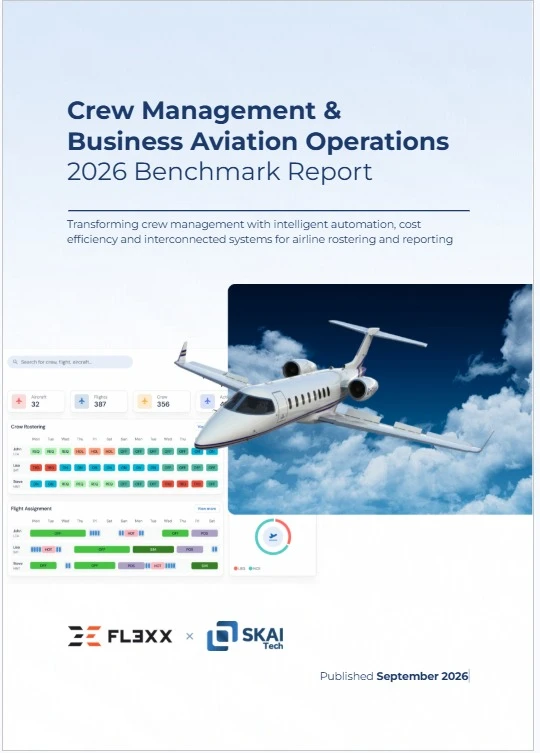
A spreadsheet remains defensible with two or three aircraft, a dozen crew members, few disruptions and an experienced scheduler. The exit signals are well known: more than two days to produce the monthly roster, hours of replanning at every disruption, or a single person who can drive the file. Our Excel vs crew planning software comparison sets out those thresholds. That scheduler is rarely a large team, either: according to the FL3XX × SkAI Tech Crew Management Benchmark 2026, a survey of 30 business aviation operators, the typical Ops/Crewing team is 1 to 3 people for fleets of up to 15 aircraft, 81% of operators describe their headcount as stretched, and 85% are not "very confident" in their rostering process.
A suite module is the right first move when the operator has no structured operations system yet. That is the foundation: without clean flight and crew data, there is nothing to optimise.
A generic workforce scheduler helps with ground logistics and administration, but it knows nothing about flight and duty time limits or type ratings. So it cannot answer charter's central question: who can operate this flight.
An in-house build is justified by genuinely unusual internal rules, provided you accept a regulatory maintenance cost that never stops. The rules do move: Delegated Regulation C(2026) 6142, adopted by the European Commission on 8 September 2026, creates separate FTL subparts for charter and for air taxi, applicable from 15 October 2028. An in-house tool will have to follow that change at its own expense.
An optimisation add-on fits when the operations system is fine but rostering has hit its ceiling: high unpredictability, frequent last-minute assignments, strong seasonality, a need for demonstrable fairness between crew members.
Where does SkAI Tech sit?
SkAI Tech is an optimisation add-on: it does not replace the operations management system, it connects to it by API, and it runs in production with FL3XX, Cyberjet and Leon Software. The system in place stays the source of truth for flights and crew; SkAI Tech generates ON/OFF patterns against the applicable rules, computes availability, optimises flight-to-crew assignment, and tracks key crew metrics in a customisable dashboard.
What that produces at equipped operators: an average roster generation time of 12 minutes and 20% fewer roster deviations. These results were observed across SkAI Tech deployments in 2025-2026, over more than 70 aircraft and 900 crew members, and vary with fleet size and operating model. Connecting a supported FMS takes about an hour, and most operators are live within four weeks. Data is hosted in Paris, under a GDPR-compliant framework.
What it does not do, and this should be said plainly: quotes, maintenance or document management. None of that is the scope of a rostering add-on.
Comparing tools for a charter operation? See what SkAI Tech changes for non-scheduled operators.
How do you run an honest comparison?
Three tests will tell you more than ten demos:
- The past-month test. Ask each candidate to generate a roster on your own data from a month you have already flown, then compare it with the roster you actually produced: coverage, load distribution, positioning.
- The change test. In the demo, move a flight by three hours and watch what the tool re-checks on its own.
- The unusual-rule test. Take the most specific constraint in your operation and ask how it is configured. "We can develop that" is a different answer from "that is a setting".
FAQ
Do we have to choose between an ops suite and a rostering add-on?
No: an add-on presupposes an operations system, which it complements. The real alternative is the suite's crew module versus a specialised add-on on top of the suite. Our comparison of an optimisation add-on versus an all-in-one suite develops the point.
Can a generic workforce scheduling tool do the job?
For ground teams, yes. For flight crew, no: it ignores rolling flight and duty time windows, type ratings and recency. The risk goes beyond inconvenience: it is non-compliance.
How long does an add-on take to implement?
Most of the lead time goes into connecting the data and configuring the rules. With no system migration and no workflow change, the switch is measured in weeks: at SkAI Tech, about an hour to connect a supported FMS, and four weeks to go live for most operators. Qualification and validity data are the first thing to get in order, since every availability calculation depends on them.
How do you avoid being led by the demo?
By imposing your data and your cases. A demo on a prepared dataset shows what the tool can do; a demo on your July shows what it will do for you.
Sources
- FAQ and Integrations page of this site: add-on positioning, production connections (FL3XX, Cyberjet, Leon Software), set-up time, data hosting.
- SkAI Tech indicators (first-party data): average generation time and reduction in roster deviations observed across 2025-2026 deployments, over more than 70 aircraft and 900 crew members, varying with fleet size and operating model.
- FL3XX × SkAI Tech (2026, August), Crew Management & Business Aviation Operations — 2026 Benchmark Report: survey of 30 business aviation operators (size and strain of crewing teams, confidence in the rostering process).
- European Commission (2026, 8 September), Commission Delegated Regulation amending Regulation (EU) No 965/2012 as regards the flight and duty time limitations and rest requirements for air taxi, emergency medical services and single-pilot operations, C(2026) 6142 final: Subparts FTL (A) and FTL (B), application from 15 October 2028.