Research
Crew roster fairness: three indicators that end the argument
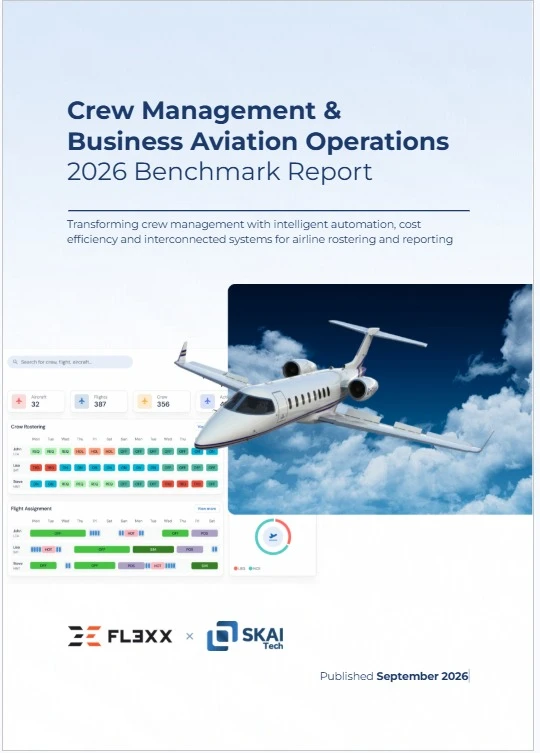
Roster fairness can be measured with three indicators: the duty spread between crew members, the share of days-off requests granted, and the volume of extra duty days. The FL3XX × SkAI Tech Crew Management Benchmark 2026 finds that roughly half of business aviation operators still collect those requests with no structured system: they arbitrate without being able to measure.
Fairness stays a matter of impressions for exactly as long as nobody puts a number on it. Everyone has one, the planner included, and the conversation goes round in circles. The 2026 benchmark ties fairness to measurable quantities, and shows along the way that most operators currently have no means of producing them. The figures below cover business aviation operators running from fewer than 5 to more than 30 aircraft; they do not carry over to regional, ACMI or medevac operations without checking.
Why is roster fairness so hard to hold?
Because it is never the planner's first objective. The first constraint is flight coverage: every rotation has to leave with a crew that is qualified, legal and available. Fairness comes next, when there is time left to deal with it.
There is little. According to the FL3XX × SkAI Tech Crew Management Benchmark 2026, a survey of 30 business aviation operators, 81% describe their crewing headcount as stretched, 88% spend significant time firefighting, and 85% are not "very confident" in their rostering process. Under that pressure, a captain's day-off request is never really arbitrated. It goes through if nothing collides with it: arbitration by default.
How do operators collect days-off requests?
For roughly half of them, by phone, WhatsApp or email, with no structured system behind them, according to the same benchmark. Requests arrive as a stream, through different channels, with no shared timestamp and no agreed priority rule.
The report describes a Director of Charter who printed every request received and ranked them by arrival time: slow work, described as a source of anxiety, because of the effort to keep everyone happy.
Two things stand out in that account. The real arbitration rule, first: arrival order, in other words how closely each crew member watches their inbox, with no regard for the load they carried in previous months (see our article on crew leave planning). The mental load, second: the planner knows they are deciding without data, does it alone, and has nothing but good faith to offer when a decision is challenged.
Which indicators measure roster fairness?
Three are enough to move past impressions, and they are the ones the report documents deployment results against:
| Indicator | What it reveals |
|---|---|
| Duty spread between crew members | Is the load shared, or concentrated on the same people? |
| Share of days-off requests granted | Are preferences an input to the calculation, or just a wish? |
| Volume of extra duty days | How much slack is the roster borrowing from the crew? |
Across SkAI Tech deployments in 2025-2026, the report records −19% duty spread between crew members, +14% days-off requests granted and −15% extra duty days. These results were observed across those deployments and vary with fleet size and operating model.
What makes them useful is less their size than their nature. They are quantities an operator can track month after month, bring to a staffing meeting, and put in front of an individual complaint. A crew member who says "I always get the weekends" can be answered with a measured spread rather than a competing impression. For a finer grid (arduous duties, days off recalled, comparison within the same qualification), see our article on on-demand flying without burning out crews.
Why is fairness a fatigue issue before it is a social one?
Because extra duty days do not disappear: they migrate to whoever says yes. In the FL3XX × SkAI Tech Crew Management Benchmark 2026, human factors (fatigue, sickness, unavailability) are the leading driver of unplanned changes, cited by 77% of operators.
The loop is short. An unbalanced roster loads a handful of crew members, they tire, fatigue generates unplanned changes, and recovering from those changes loads the same people again. The report puts it this way: "The same sick call is a non-event for an operation with slack, and a cancelled charter for one without."
In the smallest operations, the report also describes the last link in that chain: an executive who flies more themselves whenever a pilot is missing. Fairness is therefore not only about crew members relative to one another; it says who, in the company, is acting as the reserve. Managing that risk has its own regulatory framework, covered in our article on FRMS and fatigue risk management.
What does the benchmark say about crew retention?
Directly, nothing: the report publishes no turnover rate, and this article will not put one forward. What it documents is the ground on which departures build up.
A crew member rarely leaves over one bad month. They leave over an accumulation: extra duty days that nobody was counting, requests refused without a reason anyone could state, and the well-founded sense that the same colleagues always absorb the load. Those three grievances map onto the three indicators above. An operator who cannot produce them can neither answer a resignation with facts nor see the next one coming.
The market makes those departures expensive. Per Oliver Wyman (October 2023), captains' pay has risen 46% since 2020 at major US airlines and 86% at US regionals. The scope is North American and scheduled, and the firm has since revised its shortage projections downwards; the pay increases, however, are here to stay: recruiting costs more, and retaining crew gets harder when the alternative pays better (see our article on the pilot shortage in business aviation). A fair roster does not make up for a pay gap. It is, however, one of the few levers a small operator can pull without entering a salary race.
Should preferences be negotiated, or built into the calculation?
That distinction decides everything else. A preference handled after the roster is generated has to be negotiated; handled during generation, it becomes a constraint of the model. Only the second approach scales.
Negotiated afterwards, preferences land on a finished plan. Every concession opens a gap that has to be closed elsewhere, with no way of assessing the knock-on effects, and the arbitrator is still a planner juggling dozens of other issues. Built into generation, they enter the same calculation as FTL limits, type ratings and base coverage: the engine looks for a roster that satisfies all of them, and a conflict shows up before publication rather than after.
The report puts this requirement first among the five characteristics it expects of a modern solution: a unified view of the problem, in which the long-term roster is evaluated within a single constraint context, rather than a stack of local fixes whose propagation nobody tracks. It is also what ends first-come, first-served: faced with 1.4 × 10²³ possible rosters for just 14 flights and 10 crew members, a planner cannot compare whole distributions; an optimisation engine can.
Does fairer rostering mean replacing the operations system?
No, yet it is the fear that stalls the decision most often. SkAI Tech connects as an API add-on to the existing operations system, FL3XX among others, which remains the source of truth for flights, crew and qualifications. The roster distributes ON and OFF duty days around holidays, rest preferences and training, and the dashboard shows the distributions actually generated: fairness becomes something the team can show rather than argue about.
In practice, the arbitration work changes nature. Days-off requests stop being a pile of messages to sort and become an input to the calculation. The planner no longer decides who asked first: they set the fairness rules, and every generation applies them. At equipped operators, generating a complete roster takes 12 minutes on average, and roster deviations fall by 20%. These results were observed across 2025-2026 deployments, over more than 70 aircraft and 900 crew members, and vary with fleet size and operating model.
Arbitrating your team's days-off requests? See how SkAI Tech builds preferences and fairness into the roster for crew schedulers.
FAQ
Can roster fairness really be quantified?
Yes, provided the measure is accepted as relative rather than absolute. The duty spread between crew members over a given period, the acceptance rate of days-off requests and the volume of extra duty days are enough to compare one month with the previous one and one crew member with their peers, ideally within the same qualification. That comparison is exactly what the conversation lacks today.
Does a fairer roster cost flight coverage?
The benchmark documents no such trade-off. Across SkAI Tech deployments in 2025-2026, the fairness gains are reported alongside a 21-point gain in direct flight coverage, obtained by releasing +0.42 duty days per pilot per month (results vary with fleet size and operating model). Both results come out of the same optimisation: one was not paid for with the other.
What about the requests we have already received by WhatsApp?
They remain valid, provided they reach a common format, however basic, before the roster is generated. What matters is not the collection tool but the moment preferences come into play: fed in upfront, they shape the solution; gathered afterwards, they have to be negotiated one by one.
Do these figures apply to regional, ACMI or medevac operators?
Not as they stand. The FL3XX × SkAI Tech Crew Management Benchmark 2026 surveyed business aviation operators running from fewer than 5 to more than 30 aircraft. The mechanisms described (preferences gathered outside any system, fatigue as the leading driver of change) appear elsewhere too; the values do not carry over.
Sources
- FL3XX × SkAI Tech (2026, August), Crew Management & Business Aviation Operations — 2026 Benchmark Report: survey of 30 business aviation operators (crewing headcount, firefighting, preference collection, human factors), combinatorial demonstration, evaluation framework for a modern solution.
- SkAI Tech deployment results 2025-2026, quoted with the report's caveat: results observed across those deployments, varying with fleet size and operating model.
- Oliver Wyman (2023, October), North American Pilot Shortage Shows 23% Smaller Gap In 2032: captains' pay +46% (major US airlines) and +86% (US regionals) since 2020.
- SkAI Tech indicators (first-party data): average generation time and reduction in roster deviations observed across 2025-2026 deployments, over more than 70 aircraft and 900 crew members.