Research
A fragmented toolset: how business aviation operators actually roster
The FL3XX × SkAI Tech Crew Management Benchmark 2026 describes an industry rostering on a patchwork rather than a system of record: 85% of operators have a centralised crewing team, but of one to three people, and 77% run several rostering models in parallel. The difficulty comes from that coexistence.
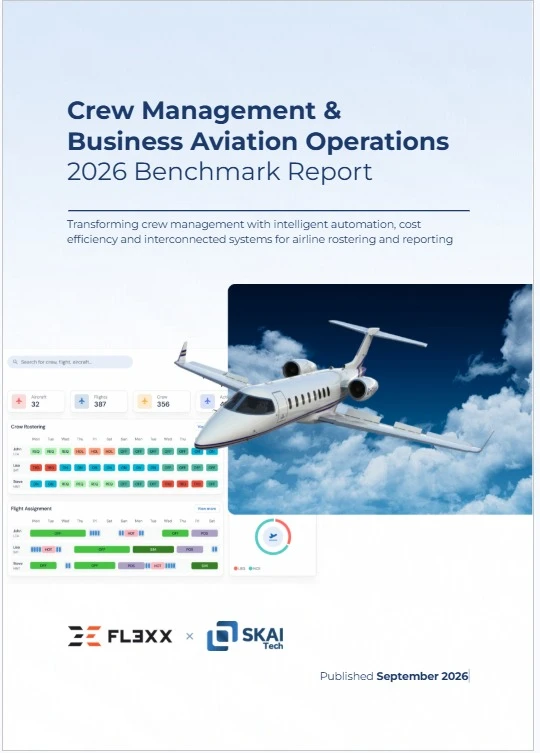
It is tempting to assume that rostering complexity in business aviation comes from picking the wrong model: fixed patterns where dynamic pooling was needed, or the reverse. The Crew Management & Business Aviation Operations 2026 Benchmark Report, published in August 2026 by FL3XX and SkAI Tech, tells a different story. The models are not alternatives. They coexist inside the same operation, on the same fleet, in the same week, and that coexistence, far more than the model chosen, is what defeats the toolset. The data below covers business aviation operators running from fewer than 5 to more than 30 aircraft, and does not transfer as-is to regional, ACMI or medevac operations.
How many people actually build the roster?
One to three. Per the FL3XX × SkAI Tech Crew Management Benchmark 2026, a survey of 30 operators, 85% of operators have a dedicated Ops/Crewing team. Rostering is genuinely centralised, not devolved to each base. But for fleets of up to 15 aircraft, that team is typically one to three people.
The headcount looks thin, and it is consistent with the sector's cost structure. What follows from it is the harder part: every rule, every type rating, every crew member's habits and every owner's contractual quirk live in two or three heads. The same benchmark records that 81% of operators describe that headcount as stretched and that 88% spend significant time firefighting: 23% in pure firefighting mode, 65% in a balance between planning and reaction.
Why do 77% of operators run several rostering models at once?
This is the survey's most structurally important finding. Per the FL3XX × SkAI Tech Crew Management Benchmark 2026:
| Rostering model | Share of operators |
|---|---|
| Fixed rotation patterns (7/7, 7/5…) | 54% |
| Dynamic pooling | 46% |
| Crew permanently dedicated to one aircraft | 38% |
| Operators combining more than one of these | 77% |
The total runs well past 100%, and that is the point: these models add up rather than replace one another. The same operator will run part of its fleet on a 7/7 pattern, feed on-demand charter from a dynamic pool, and keep a crew permanently attached to an owner's aircraft because the contract says so.
Taken one at a time, each model is simple. A fixed pattern fits in a spreadsheet. A dynamic pool needs visibility on availability. A dedicated crew is just an assignment constraint. What no tool handles easily is holding them together: the pool has to absorb the fixed pattern's absences without breaking it, and every dedicated crew shrinks the pool available for everything else.
How does base structure make this worse?
By adding a second dimension to the same decision. Again per the benchmark, 31% of operators work from a single fixed base, 58% are multi-base, and 31% have fully distributed, home-based crews.
Most operators therefore decide not only who flies but where they start from and how they get there. The report notes that this structure produces recurring deadheading simply to bring crew to aircraft, a cost that appears on no roster line while consuming both duty time and budget.
On top of that sits a constraint nothing works around: crews hold non-interchangeable type ratings. A pilot who is available, rested and well positioned but not rated on the aircraft solves nothing. The report describes this as a siloing effect: the resource exists, it is simply unreachable for that particular flight.
Does the current toolset inspire confidence?
No, and that finding ties all the others together. Spreadsheet, ops-system module or dedicated tool: whatever the tool is, it is not producing confidence. Per the FL3XX × SkAI Tech Crew Management Benchmark 2026, 85% of operators are not “very confident” in their rostering process; only 15% are.
When more than eight operators in ten remain uncertain, the gap is not one missing feature. The toolset does not cover the problem it was brought in for, which is several models coexisting on a shared fleet and shared bases. For a comparison of the possible approaches, see our article on Excel versus crew planning software.
Why does the patchwork hold at all, and at what cost?
It holds because people hold it. Three in four operators use freelance or contract crew, according to the benchmark, and one in two describes that as a band-aid rather than a strategy. The report separates two uses: 35% rely on it as an operational bridge while recruitment or training completes, 31% out of necessity in the face of a shortage or an unplanned departure (see our article on freelance crew in business aviation).
The rest of the cost is paid in slack. The report puts it this way: “What separates operators is therefore not how often disruption arrives, but how much of it their roster can absorb. The same sick call is a non-event for an operation with slack, and a cancelled charter for one without.” A fragmented toolset does not cause disruption. It prevents anyone from knowing how much margin is left before disruption costs a flight.
What does it take to handle that coexistence in a single pass?
A single view of the problem. The report shows the scale through orders of magnitude: from a pool of just 14 flights and 10 crew members, the number of possible rosters reaches 1.4 × 10²³; a human planner evaluating 1,000 rosters per second would need 321 times the age of the universe to work through them (see our article on the combinatorial explosion). The point goes beyond raw speed: a sequential method, fixing one model, then the next, then the base problem, explores only a tiny corner of that space, with nothing to guarantee it finds the right trade-off there.
From that, the report derives five characteristics of a modern solution, usable as an evaluation grid as they stand:
- Unified view of the problem: the long-term roster evaluated in a single constraint context, across all models at once.
- Continuous feasibility evaluation: problems surfaced before the disruption, not during.
- Visibility on constraint margins: how close to its limit each activity actually sits.
- Propagation awareness: local changes evaluated for their network consequences.
- Risk-based prioritisation: issues ranked by operational impact.
None of the five requires replacing the operations system. SkAI Tech connects as an API add-on to the system already in place, whether FL3XX, Cyberjet or Leon Software: flights, crew and qualifications stay where they are, while the unified view and the optimisation sit on top. That is what allows fixed patterns, dynamic pooling and dedicated crews to be handled in one pass, without asking the operator to give any of them up. At equipped operators, generating a complete roster takes 12 minutes on average, and roster deviations fall by 20%. These results are observed across 2025-2026 deployments, covering more than 70 aircraft and 900 crew members, and vary with fleet size and operating model.
Want to keep your operations system? See how SkAI Tech connects to it without replacing anything.
FAQ
Do we have to choose between fixed patterns and dynamic pooling?
The benchmark suggests the question is badly framed: 77% of operators surveyed run several models in parallel. The real task is to have a tool that holds both without one degrading the other.
Is a two-person crewing team understaffed?
Not necessarily. One to three planners for a fleet of up to 15 aircraft is the typical configuration the survey records. The documented problem lies less in the headcount than in its condition: 81% call it stretched and 88% spend significant time firefighting, so the available time goes into reaction rather than planning.
Does multi-base operation require a different tool from single-base?
Mostly it requires treating positioning as a decision variable rather than a consequence. With 58% of operators multi-base and 31% running home-based crews, deadheading is not an edge case: it is a permanent component of what a roster costs.
Do these findings apply outside business aviation?
Not directly. The FL3XX × SkAI Tech Crew Management Benchmark 2026 surveyed business aviation operators running from fewer than 5 to more than 30 aircraft. A regional, ACMI or medevac operator will likely recognise the coexistence of models, but the proportions quoted here hold only for that scope.
Sources
- FL3XX × SkAI Tech (2026, August), Crew Management & Business Aviation Operations — 2026 Benchmark Report: survey of 30 business aviation operators (crewing headcount, rostering models, base structure, confidence in the process, use of freelance crew), combinatorial demonstration, evaluation framework for a modern solution.
- SkAI Tech indicators (first-party data): average generation time and reduction in roster deviations observed across 2025-2026 deployments, over more than 70 aircraft and 900 crew members.