Operations
Pilot retention: the underrated role of rostering
Pilots rarely resign for one reason, but they almost always resign after a run of rostering decisions: OFF days taken back, leave refused without explanation, hard trips landing on the same people. The roster does not replace a pay policy; it decides when a pilot starts taking recruiters' calls.
Retention is treated almost everywhere as a compensation and career-path question. Both are real levers, and both are slow and expensive. The roster produces an effect within a few cycles, and it is entirely under the operator's control.
Why do pilots leave?
Three families of reasons, only one of which is beyond rostering.
Pay and career trajectory. The most visible lever, and currently the tightest: according to Oliver Wyman (October 2023), captains' pay has risen 46% since 2020 at major US airlines and 86% at US regionals. The scope is North American and scheduled, and the firm has since revised its shortage projections downwards (see our article on the business aviation pilot shortage); the pay rises, however, are locked in. Few business aviation operators can follow that curve. It signals a market trend, not a scale you have to match.
The flying and the aircraft. A pilot who wants long-haul or a specific type will leave, whatever the roster looks like. Rostering cannot change that motive, beyond making qualification pathways visible.
Working-life conditions. Predictability, OFF days honoured, perceived fairness, how leave requests are handled, night exposure. This is the motive rostering acts on directly, because the roster is what produces it.
It is also the fastest to improve: it needs no salary budget and no fleet renewal, only a method for building the roster.
What does a “predictable” roster actually mean?
The word covers three different things, and the confusion is expensive.
- Publication predictability: the roster is published on a fixed date, with a known horizon. This is the floor. A roster published on a moving date is not predictable, however long its horizon.
- Structural predictability: OFF days follow a recognisable rhythm. In on-demand flying this is what replaces predictability about the content of the days (see our article on on-demand flying without burning out crews).
- Post-publication stability: how much the published roster changes before it is flown. This is the dimension crews care about most, and the only one that measures objectively.
An operator can be excellent on the first two and poor on the third. Crews will remember the third. That is why fewer roster deviations, usually presented as an operational gain, is first of all a people metric.
Can fairness be measured?
Yes, and measuring it is what allows a discussion that is not a contest of impressions. The fairness that matters is within a qualification: a captain on a given type is compared to peers on the same type, not to the whole fleet. The indicators that make it measurable (duty spread, OFF days reclaimed, hardship, requests granted) are set out in our article on crew roster fairness.
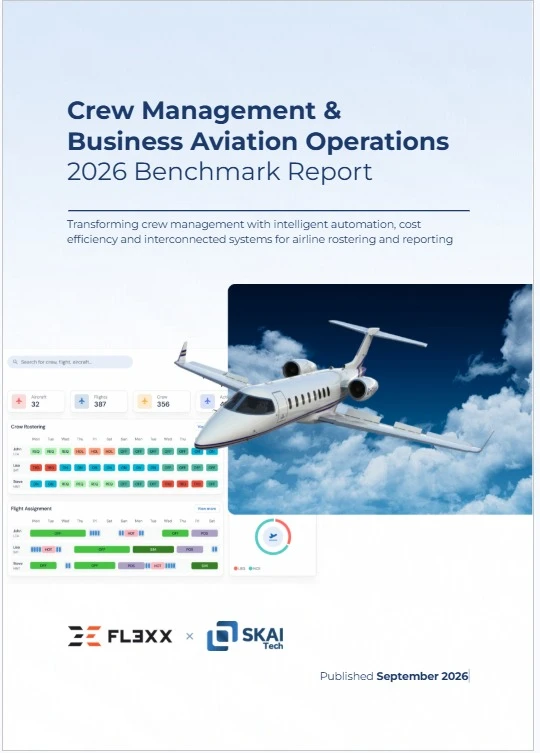
That assumes the requests arrive somewhere they can be counted. In the FL3XX × SkAI Tech Crew Management Benchmark 2026, a survey of 30 business aviation operators, about half still collect leave and preferences by phone, WhatsApp or email, with no structured system. Without timestamped, comparable requests, arbitration happens from memory and fairness becomes impossible to evidence, which is exactly what crews object to.
The same report sizes what happens once fairness becomes a build objective: across SkAI Tech deployments, the duty spread between crew members falls 19% and days-off requests granted rise 14%. One says the load is shared better; the other says the slack that frees up goes back to the crews rather than only to the programme. Results observed across 2025-2026 deployments, varying with fleet size and operating model.
Can rostering offset a pay gap?
No, and that should be said plainly. No amount of roster quality offsets a major pay difference for an early-career pilot building a progression.
What the roster does do:
- it delays the moment a satisfied pilot starts looking;
- it retains the profiles for whom life stability outweighs pay progression, often the most experienced, the ones whose replacement costs the most;
- it prevents avoidable departures: the ones where no competing offer was actually better, and the situation had simply become unliveable.
No public source measures what share of departures falls into that last category, and this article will not put a number on it. It is, however, the only one an operator can act on without new budget.
How do you act without losing coverage?
The objection is fair: protecting OFF days and honouring leave looks like giving up capacity. In practice the trade-off is less direct than it appears.
- Some coverage is recoverable through assignment. Assigning “the first available” often consumes the crew member who would have been indispensable three days later. Assignment optimised across the full horizon frees margin without adding headcount.
- Preferences belong as a secondary objective. Behind compliance and coverage, they consume existing slack without creating or destroying it (see our article on crew leave planning).
- Re-generation speed changes the arithmetic. When a compliant roster rebuilds in about twelve minutes, granting a leave request no longer means days of manual replanning. The cost of saying yes falls.
At operators running SkAI Tech, generating a complete roster takes 12 minutes on average, and roster deviations fall by 20%. These results are observed across 2025-2026 deployments, covering more than 70 aircraft and 900 crew members, and vary with fleet size and operating model. The time freed goes back into the work that matters, as the crew planning manager at Air Antilles, a SkAI Tech customer, describes: “The time savings are significant. We can now focus on specific adjustments, manage disruption, and better anticipate training and recruitment needs.”
Running operations and watching crews leave? See what SkAI Tech changes for operations leaders.
Which metrics should you track to steer retention?
Five, all produced by rostering data:
- OFF days honoured (published versus actually kept).
- Roster deviation rate (changes after publication).
- Average response time to leave requests: silence is read as refusal.
- Within-qualification load spread over 90 days.
- Qualifications expiring within 90 days: leaving them unhandled creates operational risk and a sense of professional neglect at the same time.
Tracked monthly, these five flag a deterioration well before it turns into resignations.
FAQ
How long before rostering shows up in retention?
Several quarters. Retention responds to consistency, not to gestures: one impeccable month after six chaotic ones compensates for nothing. The effect is slow and durable.
Should crews be consulted on their roster?
Collecting formalised preferences and explaining the trade-offs beats consulting without a rule. What matters is not the acceptance rate but how legible the applied rule is.
Does retention justify buying software?
It is rarely the only reason, but it is the least visible part of the return: one avoided departure saves a recruitment, a training cycle and several months of reduced capacity. That cost is real even when nobody books it.
Is an optimised roster necessarily worse for crews?
No, it depends entirely on the objectives given to the engine. Optimising for cost alone produces hard rosters; optimising with fairness and preferences in the objective produces the opposite, at equal coverage. See our article on AI crew roster optimisation.
Sources
- FL3XX × SkAI Tech (2026, August), Crew Management & Business Aviation Operations — 2026 Benchmark Report: survey of 30 business aviation operators (collection of leave and preferences).
- SkAI Tech deployment results 2025-2026, quoted with the report's caveat: results observed across those deployments, varying with fleet size and operating model.
- Oliver Wyman (2023, October), North American Pilot Shortage Shows 23% Smaller Gap In 2032: captains' pay +46% (major US airlines) and +86% (US regionals) since 2020.
- SkAI Tech indicators (first-party data): average generation time and reduction in roster deviations observed across 2025-2026 deployments, over more than 70 aircraft and 900 crew members.
- Customer testimonial published on the SkAI Tech website (Air Antilles).